Fiscal Policy and Tax Governance
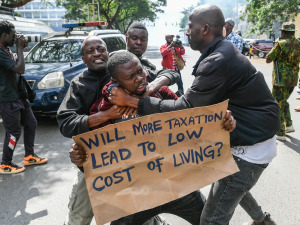 Our work seeks to strengthen and promote just and fair people centered fiscal policies. Over the past years, the tax trends have been on an increasing trajectory in a manner that raises concerns for equity and fairness. While governments are pressed to meet new tax revenue generation targets to finance increasing priorities. There is concern that the imposed taxes are widening the income gap between the poor and rich. Moreover, the increasing taxation of vital social services is exacerbating social-economic injustice. Consequently, between 2023 and 2024 there were tax protests in Uganda, Kenya and Tanzania.
Government’s mandate to tax its citizens is a constitutional obligation. However, with dwindling foreign aid, it appears the governments in East Africa have resorted to squeezing everywhere to raise some dime.
Taxation and a strong tax system enables the state to raise necessary revenues to finance social services and development. The action of taxation establishes a fiscal social contract between citizens and the taxing state . It may improve governance as taxpayers have a legitimate cause to expect something in return for paying taxes and are more likely to hold their governments to account. Governments have a stronger incentive to promote economic growth when they are dependent on fair taxes. However excessive taxation beyond reasonableness can break the back of the economies and citizens.
 Under this program, we seek the governments balance between taxation and economic justice. We undertake and produce targeted analytical briefs and public dialogues on tax trends, DRM and assessments of fiscal policy reforms. We contribute to suggestive recommendations on how EAC governments can increase their tax to GDP ratios and effective tax rates without imposing a burden and economic stress on citizens. Based on tax models, we further attempt to provide options that government can leverage to achieve similar tax revenue outcomes without excessive tax burdens. Our work includes:
- National and EAC Regional Budget Analysis and Advocacy convenings
- Tax and Tax justice clinics
- Technical Support and Advisory
Digital Economy and Financial Inclusion
This program focuses on supporting governments to expand the digital economy, leverage of monetary policy and regulation to harness the dividends of the digital economy, block chain and cryptocurrencies as vehicles to advance financial inclusion in the region.
The digital economy offers a new frontier for economic policy. Over the past years, East African countries have recorded digital economic expansion characterized with increased internet penetration, mobile phones, and online financial services.
Mobile internet penetration in East Africa stands at approximately 52%, with mobile data serving as the primary driver of connectivity. Kenya leads the region with a ~72% penetration rate and 58.5 million data subscriptions, while Tanzania follows at 55%. Digital financial services (DFS) penetration in East Africa is increasing, driven primarily by mobile money.
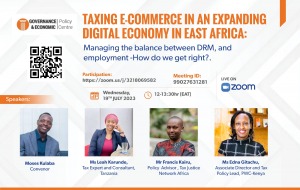 The expanded digitalization presents immense opportunities for development in Eastern and Southern Africa, including business, job creation, poverty reduction, and improved service delivery, but Countries across the region are facing similar challenges to digitalization including risks related to cybersecurity and data protection. There are gaps in governance and taxation of the digital economy. To realize the benefits of digitalization, countries need to strengthen digital infrastructure, promote regulatory harmonization, enhance digital skills, and address disparities in access to digital services. (World Bank, 2023)
Moreover, globally there is an increasing uptake in the use of block chain technology and crypto digital currencies. Yet in East Africa, government uptake and regulation are moving at a snail’s pace. The pressure to digitalize our economies and adopt a new generation of monetary policies has economic policy and practical risks. How can governments navigate this delicate balance between digital economy penetration, financial inclusion and monetary policy? We re-explore and unpack block chain and crypto currency penetration and the risk considerations shaping debate and monetary policy terrain in East Africa.
GEPC work under this program addresses;
- The Digital Economy and Crypto Currencies
- Taxation of Digital Economy
Our Activities
- Evidence Based Research, advocacy and training
- High Level Stakeholders and public interactive dialogues, webinars and colloquiums
Regional Economic Cooperation, Trade and Investment
 The East African Community (EAC) is a large regional economic block comprising of 8 countries with a total population of about 200+ million. This offers a potential market for regional trade yet the progress of regional economic integration process is slow and intra-regional trade still below maximum potential.
Although Intra-EAC trade expanded by 28% to USD 9.3bln in 2025, the level of trade and investment is still low to create equitable wealth, improved conditions and sustainable development. Non-Tariff Barriers to trade exist, obstructing smooth flow of goods and services across the region. National policies and regulatory frameworks are largely inward looking and consequently, Regional Economic Cooperation as mechanisms for promoting economic opportunity have failed to deliver tangible benefits. Economic gaps and barriers exist, and citizens are discontented and disengaged.
Moreover, the Africa Continental Free Trade Area further offers opportunities for intra Africa trade, yet trade between the EAC and Africa remains low. Although trade with Africa has increased by about 40% to about USD39bln in 2025 (about 25.2% of total trade), globally, China leads as EAC’s largest trading partner, followed by the UAE, South Africa, India, Japan and the United States. (The Citizen, April 10th , 2026).
GEPC work under this program addresses;
- Elimination of Non-Tariff Barriers (NTBs)
- Deepening of regional economic integration
Our Activities
- Evidence Based Research, advocacy and training
- High Level Stakeholders and Academia interactive dialogues, webinars and colloquiums
- Trade and Investment facilitation
- Track and Monitor Regional Economic Integration
- Technical Support to the EAC, EALA and East African Business Council on
- Capacity building for Civil society to engage with the EAC and AfCFTA on issues related to trade and regional economic cooperation
4.5 Fundraising, Resource Mobilization and Sustainability:
GEPC aspires to be a well-resourced and sustainable organization. We are actively looking for partners to support, sponsor or partner with us in delivering the projects under this program.
For more about this program contact us via: Tel: +255 754 844410/ +254 717 872034, Email: info@gepc.or.tz or moses@gepc.or.tz Website: www.gepc.or.tz