SADC in Economic Meltdown; Can Tanzania be German of the Region?

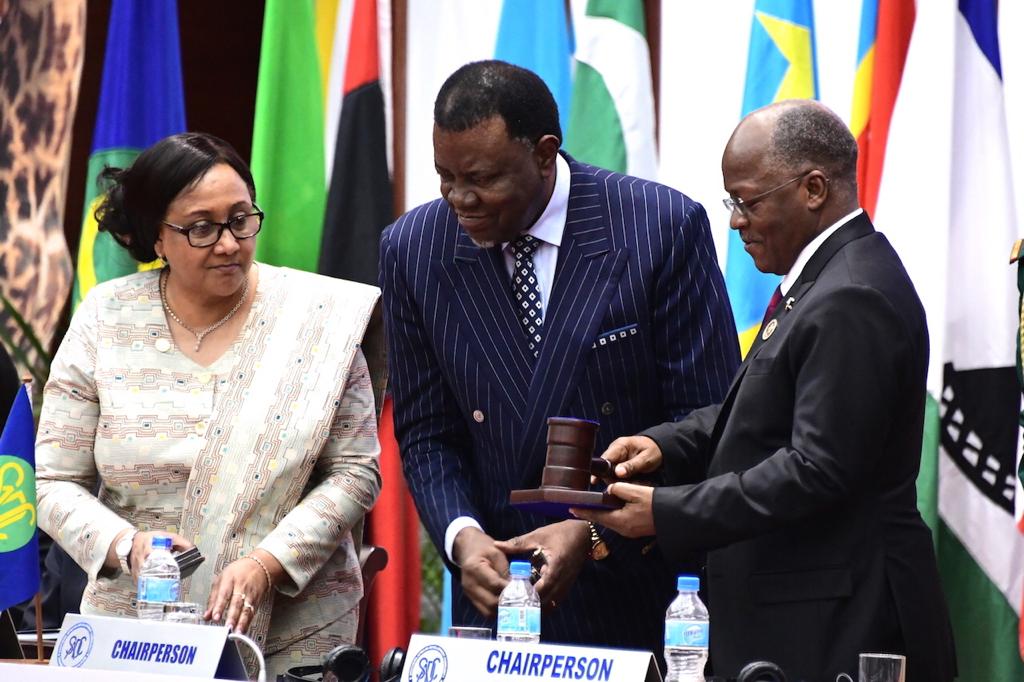
On Saturday 17th August, Tanzania assumed the chair of the South African Development Cooperation (SADC), amidst disturbing economic figures indicating that the region was facing a serious economic meltdown. Can Tanzania be the ‘German’ of the region, playing the economic big daddy role by calling the other states into political order and bailing out the struggling member states?

By Moses Kulaba, Governance and Economic Analysis Center, Dar es Salaam, Tanzania

The SADC is a 16-member state regional economic block established with among others promoting sustained economic growth and sustainable development amongst its objectives. However, the recent economic data indicates that region is witnessing an economic meltdown with most of its member states, except perhaps Tanzania, positing negative or stunted economic growth over the past years.

According to the economic and social indicators data compiled and released by its secretariat the the SADC region posted an estimated average growth rate of 1.4% in 2016 compared to 2.3% in 2015. At country level Tanzania registered the highest growth of 7% among the member states followed by Botswana with a far below rate of 4.3%[i].  

In 2017 Tanzania recorded an economic growth of 7.1% followed by Seychelles (6.3%) whilst Angola registered negative growth for the second consecutive year in order of 2.5%[ii] The region’s growth was increasing at a decreasing rate since the post global period in 2009.

The region’s economic giant South Africa has witnessed rapid economic slowdown, bring along its small neighbors and trading partners under its weight.  Countries such as Zimbabwe were collapsing under the weight of economic sanctions, Namibia and Angola recorded negative annual real GDP (at market price) of 10.8% and -2.5% respectively in 2017 due to the slump in commodity prices and other related risks. Botswana at 2.4% did not perform well either. The region posted an overall trade deficit with rest of the world of USD6.7bln. 

The AfDB report for 2018 warned that the economic outlook for Southern Africa region was cautious[iii]. Broad based economic activity was expected to recover at slow pace, but the outlook remained modest given the diverging growth patterns for the region’s economies. Upper middle income countries turned in low and declining rates of growth meanwhile lower income transitioning economies recorded moderate and improved growth, albeit at reduced rates.

Despite the improvement, economic performance remained subdued as the region’s economic outlook continued to face major headwinds. High unemployment, weak commodity prices, fiscal strain, increasing debt and high inflation.

Real GDP was estimated to have grown at an average of 1.6% in 2017 before increasing to a projected 2.0% in 2018 and 2.4% in 2019.

The future regional growth was expected to be bolstered with primary expectations of increased investment in non-oil sectors such as electricity, construction and technology in large infrastructure projects, mining as well as continued recovery in commodity prices.

However, the latest figures show that the region was not well on that front either.  The decline in commodity prices in recent years reaching the lowest point in 2015 translated into significant income loses for the economies, implying a negative impact on public and private sector spending and therefore growth in employment.

Before the 2008-2009 global recession, the region experienced moderate growth, though individual countries contributed differently. For example, Angola, Mozambique and Namibia exhibited robust growth that collectively outpaced the regional group.

Thereafter, Angola, the region’s foremost oil producer and former raising economic star received the worst bashing with its economy experiencing adverse economic growth effects due to weak oil prices.

Overall the region experienced negative GDP growth with Swaziland (-10.08%), Zimbabwe (-8.38%),  and Angola (-6.31%)  being among the worst hit[iv]  Other Countries such as Zambia, Namibia , Mozambique and Malawi were not performing better either. South Africa reported the highest public debt soaring in billions dollars followed by Angola.

South African Institute of International Affairs observed that intra-regional investment and trade levels had declined markedly since the commodity slump in 2013. Moreover, the trade and economic growth in the region remained imbalanced, exacerbating political strains among member states. Non-tariff barriers and other factors had adversely affected intra-regional trade and investment in recent years.

Assuming the mantle, at the end of its 39th Summit held in Dar es Salaam, Tanzania’ President John Pombe Magufuli was furious with against the Secretariat for having not provided adequate and alert to the political leadership that the region was experiencing an economic meltdown with reduced or stunted growth and an expanding trade deficit.

Speaking at the SADC People’s forum on the sidelines of the main summit in Dar es Salaam, the South African Professor, Patrick Bond, described the situation as alarming, catastrophic and turbulent and yet no one was bold enough to speak about it.

He was perhaps communist in view and radical in approach, blaming what he described as the capitalistic enterprise and its puppeteers for under mining economic justice, risking lives of by putting profit before the people and causing climate change whose effects were ravaging SADC but remained quite revolutionary in suggesting that the ordinary people perhaps needed to send a clear signal to its political leadership that all was not okay. The economic fundamentals were tattered and the regional leaders needed to wake, Prof. Bond lectured.

Can Tanzania emerge and become the ‘German’ of the region?

With this state of the Union, the question therefore arose can Tanzania emerge and become the ‘German’ of the region, playing the economic messiah role by providing both political leadership and economic bail out to its neighbors

In 2013 up to 2015 when the European Union experienced economic turbulence, Brussels turned to German to liberate it from the gigantic economic Dracula which was tearing down its economic block and leaving some of its small states indebted and facing bankruptcy. German wrote cheques in financial bailouts, provided guarantees and political prop up for economically struggling states such as Greece, Portugal and Italy.

German relied on its economic prowess and its political might as the industrial central pillar of the European Union. The charismatic leadership of its Chancellor, Ms Angela Merkel, was a distinct asset. Even at the risk of her own political career and constant onslaught from the German far right, Merkel could not tolerate any nonsense and was not ready to allow Europe to fall back.

In the face of the similar economic doldrums which seems now to face SADC, can Tanzania afford such muscle or a German equivalent?

Tanzania has done it before. In the 1960’s until 1990’s when the region was facing serious political, Tanzania pulled up its resources and committed it to the liberation struggle. It hosted training camps and provided pupilage to thousands of liberation fighters. Dar es Salaam became to the political headquarters of Frontline States where the idea of SADC in its current form was initiated and a spring for independence for many of the current South African states.  For some, therefore SADC at 39 years, just came back home.

In assuming the SADC Chairmanship, President Magufuli warned the Secretariat that it will not be business as usual as of now and for the next one year his interest would be to see that resources placed at the disposal of the Secretariat were not spent on conferences but on meaningful tangible projects which benefited the people. Could this be the kind of approach that region needs to take in order to deal with its increasing economic challenges.

An agile kind of leadership which places the people at the heart of politics and fights with cunning shrewdness against corruption, public waste, nepotism and personal drive to accumulate wealth by those in power.

Over the years these have been some of the vices which have dogged the region and bringing the much needed progress to stagnation and ultimate halt in some member states. Comparatively, perhaps the SADC is the largest economic group in Sub-Saharan Africa. With over an estimated population of 337.1 million people in 2017, is larger than its western equivalent, the Economic Community of West African States (ECOWAS) and obviously bigger than the European Union has a just a fraction of the SADC population yet somehow progress has been considerably steady in the other regions.

According to experts the region was faced by multiple non trade barriers and low intra region trade which still at around 20%.  Technically, speaking, the members are happy to do business with other countries outside the region rather than their economic neighbors partners in SADC. The member states are living alongside each other but not fully economically and trade integrated.

Political uncertainties which has dogged the former economic giants of the region such as South Africa, Zimbabwe, Mozambique and Angola created fertile conditions negative to investment and economic growth.  The governments lost grip on the economic mantle and directed attention towards managing internal politics and mechanics for political survival.  

Xenophobic attacks in South Africa could have also created a sense of fear and caused disarray in a fragile informal sector which was quietly the driving factor or fulcrum on which the South African economy relied. Crushing cost of electricity, turmoil in the extractive sector and stalemate in the platinum industry in 2016 perhaps were also a contributory factor to South Africa’s political woes. 

Overall, according, to Professor bond, the region was just poorly governed and a new leadership impetus led by the people was necessary to bring back the declining glories

For many years SADC was so much preoccupied on political stability. With good success, it has managed to tackle conflicts and bring peace amongst its member states. Overall, political conflict in the form of civil wars in the region has been declining with all except the DRC reporting any semblance of a conventional Civil war in recent years. 

Even, this has significantly been downgraded in recent years. Currently, there is no severe risk of any threat from any member state to destabilize any other through an arms insurrection. The ongoing conflict in the Eastern DRC is largely a war of survival for the remaining tribal and ethnic elements rather than a fully-fledged military configuration to overall and capture power in the DRC. If it can be dealt with, then perhaps the war in the DRC will be over or significantly reduced to minimal levels in many decades.

The future wars of the SADC will therefore be largely economic and perhaps resource based on key issues such as land, water and control of the real means of production and profit. Acute poverty could be the other driver of the masses towards insurrection. For Tanzania therefore, to take up the German challenge will be a touch endeavor.

Tanzania’s economic benefit or contribution to the region is too minimal. According to trade statistics, Tanzania is among the least exporters to SADC and its overall trade balance with its SADC neighbors was still low. It therefore lacks the economic might of German stature.

Over the past three years Tanzania’s political leadership has commitment itself to building its economy first before looking outside. Cutting back on public waste and flogging its population into line to start paying up taxes to finance its public service and infrastructure ambitions, Tanzania is building its economy from within.

Throughout the 1960s to the 1990s Tanzania sacrificed a lot in order to politically liberate virtually all the SADC member states and yet gained very minimal in return.  Political historians have even have even argued with some level of confidence that Tanzania under developed itself in sacrifice for others to develop. Tanzania would be therefore quite cautious in economic diplomatic terms and perhaps uncomfortable at this moment in giving out too much of what it has acquired over the years to salvage its economic neighbors.

The conditions in the region appear to have turned so bad in the past few years with persistent drought raving across the region only to be replaced by wrecking floods leaving behind famine and death in communities along its way.  Approximately over 1000 people dies in the last floods in Mozambique and Malawi caused by cyclone Idai and Keneth. Millions at a risk of starvation.  Essential infrastructure such as road and bridges connecting rural areas to urban centers and across countries such as the port of Beira are badly battered and incapable of supporting economic productivity.

The region has not been able to attract in Foreign Investment into its natural resource wealth and flagship infrastructure projects such as the Mighty Inga dam electro power project in the DRC which would have brought life into the SADC power master plan have remained incomplete for many years now. The region is badly in need of both reconstruction and reconfiguration to sustain itself and its ambitions.

At the end of the summit Tanzania’s former President Benjamin Mkapa advised that SADC member states should stop relying heavily on foreign donors for aid to support or finance their development agenda. Building internal capacity through a reliable market for products from the block, investment in education, technology, domestic revenue collection and unlocking the potential amongst its budging population to drive the economies forward would be a better option. Perhaps the SADC leadership should fine tune an ear to the wisdom of its elders.

The meeting concluded with signing off of three development cooperation programs worth 47 Million Euro deal with the European Union under its European Development Fund (EDF) 11 financing round. According to official statement, the funds will be used over the next five-year period to support improvement in the Investment and Business Environment (SIBE), Trade Facilitation Program (TFP) and Support to Industrial Productive Sectors (SIPS) three programs to be implemented by the SADC over the next five-year period

The SIBE program aims at achieving sustainable and inclusive growth and job creation by transforming the region into an investment zone, promoting intra-regional investments, foreign Direct Investment and a focus on Small and Medium Enterprises. The TFP will contribute to enhance inclusive economic development in the region through deepened economic integration while the SIPs aimed at contributing to the SADC industrialization agenda, improving performance and growth of selected value chains. How this EU injection translates into lifting the region from its economic downward spiral will yet to be found out at the next summit when SADC turns 40. What is clear is that something has to be done.

[i] SADC: Selected economic and social indicators, 2016

[ii] SADC: Selected economic and social indicators, 2017

[iii] AfDB: Southern Africa Economic Outlook, 2018

[iv] https://countryeconomy.com/countries/groups/southern-african-development-community
Why governments should not sign Economic Partnership Agreements (EPA) with the European Union without negotiation

Why governments should not sign Economic Partnership Agreements (EPA) with the European Union without negotiation

By Moses Kulaba, Governance and economic analysis centre, Dar es Salaam-Tanzania

From the tenets or principles and its design, the EPA offers critical economic challenges. Indeed, according, former Tanzanian President, HE Benjamin Mkapa, has cautioned that signing the EPA less developed Countries like Tanzania will be signing off an economic death warrant to their industries and jobs. Similar sentiments have been echoed by President John Magufuli when he described the EPAs as a form of colonialism and bad for our Country. Experts have equally warned against signing EPAs in their current form and content-perhaps there is reason to fear

The Economic Partnership Agreements (EPA) are bilateral agreements signed between less developed Countries and the European Union which allows free access of goods and services to   the European Union and vice versa. At the core of the EPA’s are said to be free trade between Less Developed Countries and the European Union.  They were set to replace the current existing trade relationships under the Cotonou Agreement and any other preferential trade related provisions such as the Everything But Arms (EBA).

It is from this perspective that as an expert and economic diplomat, I would advise Tanzania’s government and other least developed countries (LDCs) not to sign EPAs in their current form and pursue any future negotiations with utmost caution.

Firstly, EPAs would open up the Tanzanian market and industrial sector to extreme European competition this would be contrary to Tanzania government’s industrialization and job creation agenda. According to European Investment Reports in Tanzania, EU companies accounted for 68% of the total FDI in Tanzania. This makes the EU the single largest investment block into Tanzania. Under the EPA framework domestic industries will not be able to compete with their European counterparts. The EU also subsidizes its products through subsidizes extended to its farmers and industries making them unfavorably competitive.

The EPA does not guarantee free access of Tanzanian goods into the European Market. This is because the European market restrictions and non-tariff barriers such as quality controls and psytosanitary standards which are imposed by the EU on goods and services coming from less developed Countries.

According to the European Commission the net trade volumes between the EU and Tanzania amounted to1, 602 Million Euros. The EU also toped Tanzania as a trading partners with trade volumes estimated at USD2 Billion in 2016  Out of these Tanzania exported goods worth Euros632 million while it imported goods and services worth Euros 970 million creating a trade balance of Euros 338 million in favour of the EU. This therefore means that the trade imbalance would worsen   if Tanzania was to open up its markets to the European Union without any restriction.

Free trade between the EU and Tanzania would lead to high import revenue foregone by Tanzania. It is estimated that at the current figures (Usd2 billion in 2016) the trade created through signing of EPA would amount to 10 Billion. If an average amount of import duty charged on these goods is projected over the five-year period of the EPA, the government would lose billions in revenue foregone. This would be a major loss to the government which is struggling to build its tax base and aims to achieve a tax to GDP ratio of 19% by 2020.

There are other opportunities to trade with the EU exist under the Cotonou Agreement. The Everything But Arms provisions with in the current Cotonou Agreement allow Tanzania to export goods and services apart from arms to the EU on preferential terms. It does therefore not make prudent economic sense for the Country to enter into another agreement whose perceived economic benefits could be still achieved under the EBA. It would be to continue or re-negotiate with the EU under the EBA framework. The EPA may also be contrary to WTO rules of MFN. By signing the EPA Tanzania would be obliged to provide the same treatment to other nations. This would dangerously open up Tanzania’s economic to extreme competition and potential dumping from other Countries

The signing of the EPA would create a multiplicity and duplicity of membership to regional trade groupings. Tanzania is a member of SADC and EAC. By signing up to the EPA, Tanzania would also violate some of the economic rules of SADC which requires a common external tariff on goods coming from outside the SADC. The EPA requires that EAC signs as a region. This is requirement is oblivious to the fact that the different member states are at different economic levels. Kenya is a developing Country and therefore stands to benefit more from the EPA than Tanzania. Kenya’s flower market has already been a major export to the European Markets and this implies that Kenya would be a major beneficiary.

Obviously, by not signing up, Tanzania stands to lose its diplomatic darling status in the face of EU’s foreign policy to Africa. Tanzania’s good will have to meet high standards and heavily compete with other countries for entry into the European market. The non-preferential tax treatment and potential border taxes imposed by Tanzania on foreign goods may make EU products entering Tanzania’s markets to be highly priced and costly for local Tanzanians. Tanzania may be forced to seek alternative trading partners to replace on previously EU sourced goods.

Despite the potential economic benefits that appear to be offered by the EPA, if weighed the advantages of signing the EPA in their current forms has potential catastrophic consequences on Tanzania. A cautiously renegotiated approach would be the most appropriate pathway.

References

Why growing influence of Non-State Actors in diplomacy and consular practice is a cause for alarm in smooth running of State foreign affairs

Why growing influence of Non-State Actors in diplomacy and consular practice is a cause for alarm in smooth running of State foreign affairs.

By Moses Kulaba, Governance and economic analysis centre

Diplomacy has been defined by scholars such as Ernest Satow as the intelligent act of applying tact in the management of international relations by actors through relationships and interactions in the official conduct of their official activities in order to achieve the goals of their national interests guided by a nation’s foreign policy. It can equally be described as an international intercourse between sovereign states with an aim of advancing mutual interest in a peaceful manner. However, in recent years, non-state actors are becoming influential diplomats with credentials worth for government recognition.

Since diplomacy and consular practice is still largely about interaction between sovereign states, the role of the state is still significant.  However, if the current trend continues, it is likely that in the future, the state will become a player with different roles and functions, such as facilitation of diplomatic and consular interaction.

From the onset of its definition and practice, diplomacy was conceived as an activity within the exclusive purview of the state.  Realist and Classical theorists of politics and international relations at the time believed in the supremacy of the state and its dominance in diplomacy. Diplomacy was seen as a tool for seeking dominance and asserting power.

For political philosophers such as Machiavelli (1469-1527), in his book The Prince, he argued that state power and foreign relations were so sacrosanct to be entrusted with any other actor other than the prince (The leader) and the state.  For Machiavelli, diplomacy was only pursued in preservation of the safety and security of the state. This was the main goal of the state and he urged his Prince (The ruler) to pursue these interests at all costs, including war where diplomacy failed.

The realist ideas were challenged by liberal theorist such as John Locke and Immanuel Kant who saw that actors in International relations were both state and non-state actors. The world was viewed as anarchic in nature, with conflicting interests and competing egos. Restoration of the world order and the pursuit of global peace, democracy and international cooperation required a multilateral approach with multiple actors.

Indeed, overtime diplomacy has evolved. Today, diplomatic activities are carried out by non-state actors, whose activities transcend beyond their national borders and the confines of the state. 

Participation on Non state Actors in diplomacy and consular practice has become a pronounced phenomenon. Concepts such as corporate diplomacy, Non-Governmental Organizations (NGO) diplomacy, business diplomacy and conference diplomacy have become quite familiar in diplomacy and consular practice.  Experts such as Saner & Liu acknowledge that diplomacy has mutated overtime.

Globalization and democratization have rendered the professional boundaries more porous and put into question the territorial claims of the traditional diplomats. Alternative diplomatic actors have emerged within and outside the state and often act independently from the Ministry of Foreign Affairs. Diplomacy as a profession has undergone changes in terms of definition, qualification and role expectation of what is or not supposed to do  (Saner & Yiu: 2003).

The following non state actors influence postmodern diplomacy and consular practice in greater proportions than before.

International Organisations and agencies have become key non state actors influencing postmodern diplomacy.  These operate at sub regional, regional and global level, pursuing different sets of predetermined goals.  Sub-Regional international organizations such the East African Community (EAC), South African Development Cooperation, Common Market for Eastern and South Africa (COMESA) and North America Free Trade Area (NAFTA) may have economic integration agendas while continental and global international organizations such as the African Union and the United Nations respectively pursue broader international goals.

These organizations have vast resources and access to countries and interact with a wide range of actors and issues ranging from political affairs, peace to development.  They generate reports and international law documents shaping international diplomacy. They have a large membership base whose collective voices at times counteract or challenge individual state concerns. Indeed, this was one of the arguments advanced by the British Prime Minister Ms Theresa May in her campaign for Britain to exit the European Union. In her opinion, the United Kingdom as a state had become weak and most of its sovereign the powers to govern and diplomatic interaction had been transferred to Brussels. According to the ‘Brexit’ campaigners, the UK could not make foreign policy decisions on issues such trade and asylum without consulting the European Union headquarters in Brussels. The UK’s appropriate answer to this counter influence, in Ms Theresa May’s view, was to quit the European Union. The influence of the European Union in influencing the European Continental diplomacy is therefore significant and alarming its member states.

The International Non-Governmental Organisations (INGOs) are the other major non state actors influencing diplomacy and consular practice. Saners and Yiu have describes this new phenomenon as Diplomacy of International or Transnational NGOs. These operate at various levels from the national to the global level. These include INGOs such as the Oxfam, Human Rights Watch and humanitarian agencies such as the International Committee of the Red Cross and Red Crescent.

They are engaged in various activities such as environment, human rights defense, economic and social development. Some are focused on Monitoring state excesses and bad corporate behavior. They may be concerned with the negative impacts of development and exclusion of the poor. INGOs have abilities to mobilize, protest and challenge states, corporate and multilateral agencies such as the World Bank and the United Nations.

They have demanded and recieved representation in major multilateral agencies such as the United Nations. Through these representations, they have been effective in putting forward policy options, alternative models and articulating their views in the international arena, their by challenging the roles of the state and traditional diplomat in dominating policy formulation and practice at the international arena.

A good example was during the negotiations towards signing of the Kyoto protocol on climate change and the recently concluded Paris Climate Change Summit, where the environmental INGOs were instrumental into pushing the member states into signing the protocol and an agreement respectively to reduce carbon emissions and global warming. INGOs and grassroots movements were in 2000 effective in influencing the World Health Organisations and governments to negotiate the framework Convention on tobacco control with aimed at reducing exposure to effects of tobacco to the public through stringent regulations of tobacco companies and smoking in public places.

Others such as the Red Cross respond to emergencies and deliver humanitarian aid in areas of crisis.  Have strong connection with the international community and often use their extensive network to communicate with the international arena by submitting reports, policy position papers and are represented at international forums with equal status as member states, their by limiting the dominance of the traditional state in diplomacy and consular practice.

National NGOs have become influential in modern diplomacy and consular practice. These represent the interests of civil society at the national level. They constitute a broad range of Civil society ranging from small to big organizations, engaged in a broad range of issues such as corruption, economic and social development and human rights monitoring.

By constantly interacting with other foreign actors they have curved a niche in foreign relations which is now commonly referred to as diplomacy of National NGOs.  They largely receive funding from outside the Country and share their periodic reports with their local and international benefactors and constituencies. With greater access to information, they are capable of sharing their views with a wider global audience and shaping international opinion at greater speed and effect than national state actors and Ministries of Foreign Affairs (MOFA).  Their unfettered access to the global audience and influence on foreign relations is a cause of alarm in diplomatic and consular relations

Transnational Corporations (TNCs) and Multinational Corporation (MNCs) have become major non state actors in diplomacy operating across borders in both developing and transiting economies. With globalization and free movement of capital in the form of Foreign Direct Investment (FDI) companies today conduct businesses across Countries. However, this comes with a lot of challenges such as regulation, taxation, intellectual property and dispute settlement. MTNCs also interact with international organizations such as the World Trade Organisation (WTO) and the International Labour Organisation (ILO) on matters of trade and labour standards (Saner & Liu: 2001). Companies also want to keep good international reputation and their global market share.

In order to deal with these international challenges, MTNCs have been encouraged to start ‘diplomatic’ activities which promote or consolidate their operations. Examples of such include trans-national business councils and forums such as the Trans-Atlantic Business Council (TABC) which is a major forum both the US and Western Europe as a forum to coordinate their position at the WTO and other related issues. Similar forums exist in Tanzania such as the Tanzania-Nordic business forums, India Tanzania Business Council and Tanzania National Business Council (TNBC).

These business councils put forward policy positions and papers and form alliances through multiple networks (embassies) to promote their agenda.  Tanzania’s National Business Council is chaired by the President of the United Republic of Tanzania. TNCs and MNCs through their councils influence foreign policy positions of their countries and may also call for global action on matters of peace and war, thereby limiting the dominance of the traditional state actors in diplomacy. The American Oil Corporate lobbyists through the American Council on Foreign Relations were instrumental in influencing the United States invasion of Iraq in 1991 and 2003.

In underscoring their roles and influence in Diplomacy and Consular practice, Saners etal and Kishna suggest that the increasing participation of MTNCs in diplomacy has contributed to the rise of new terminologies to diplomacy such as Corporate Diplomacy, Commercial Diplomacy and Business diplomacy.

Eminent Individuals are also becoming major actors in diplomacy and consular practice.  These are people with influence on global affairs and impact on diplomacy and consular relations. They include eminent persons such as the late Koffi Annan, the Aga Khan, the Dalai Lama, Bill Gates or Yousaif Malala. They have international following and always invited to international forums to share view and offer policy options. They work through various informal, formal, state and international networks to influence diplomacy. For example, Ms Malala’s views on the girl Child’s education may have more global impact than the views of an education minister from poor sovereign states. Their influence is insurmountable.

There is also an increasing debate and acceptance of the view that even ordinary individuals have influence on diplomacy. For example, when an individual makes a presentation at a global conference about his country, such a person is engaging in a form of diplomacy and his or her opinions may shape the perception and views of other states against his or her Country. Although this debate is not conclusive, it is evident that diplomacy and consular practice is no longer restricted to state actors.

The role of organized criminal Gangs and armed Groups such as drug cartels, pirates, fundamentalist and terrorist groups such as Al-Qaida, International State in Syria and Levant (ISIL), Alshabab  and nationalistic movements such as the Free Syrian Army and Revolutionary Armed Forces of Colombia (FARC) are equally becoming major actors in diplomacy and consular relations.  These operate across borders and have significant influence on the politics, economy, peace and security in the territories where they operate. They have access to vast resources and may use their extensive international network for mobilization and propaganda.

Recent history has shown that conflicts are largely involving non state actors. The 2001 attack on the World Trade Center by Al-Qaida operatives working through a wide network of operatives and alliances has shaped the post 911 era and global approach to peace and security. After the 2001 attack on the World Trade Center, many Countries strengthened their national security apparatus by enacting strict security and counter terrorism laws. The US reviewed its relations with some states by blacklisting them as state sponsors of terrorism. The role of the UN in addressing global peace was effectively discussed and its influence as a multilateral body for pursuing global peace and diplomacy was discussed. This discussion continues to date.

In some Countries organised criminal networks have worked to overthrow or install governments and contributed largely to instability forcing state actors to negotiate for peace. A good example is the FARC in Colombia and the ongoing peace talks between the Syrian Government and the Free Syria Armed forces.

These actors have drawn states into international wars such as the US led Coalition in Afghanistan, Iraq and the current ongoing conflict in Syria and Yemen. The US has also increased its military presence in the Middle East and Africa including establishing an African Command to oversee US engagement in Africa in operations such as tracking the Lord Resistance Army (LRA) in Central Africa Republic and overseeing Counter Piracy Operations in Somalia. Clearly, their influence on diplomacy and consular practice is evident.

The Media is becoming a major non state actor in diplomacy and consular practice. The advent of the internet and social media has opened forums for influencing diplomacy and consular practice to non-state diplomats. Access to the media and global community is no longer an exclusive of the state. The media and internet have challenged the power relations between the state and non-state actors. Through the internet and various social media practitioners, citizens and individual bloggers can interact with the world with greater speed and access than state actors. Using social media platforms non state actors can create content, develop imagery and mobilize. They can shape and influence foreign relations and diplomacy by sharing their independent thoughts. Through social media, they are able to galvanise support and determine, extend or counter the foreign policy of their countries. An example of the increasing role of the media was during the Arab spring in 2011 where social media, the internet and mobile phones were used to mobilize support and participation in the overthrow the governments in North Africa and the Middle East.

In emphasizing the role of the media in international relations, the US and other actors have always promoted the use of the internet and social media as a vent for free speech. The US as a major global player in diplomacy has always condemned any state acts to restrict access to internet and social media.

Despite, the increasing role of non state actors, their participation in diplomacy has raised concerns within the modern field of diplomacy and consular practice. Perhaps Melisens definition and concerns (in Saner and Yiu.pp11) best captures the post modern nature of diplomacy that is characterize by simultaneous participation of multiple state and non state actors and pulse of concerns generated from their influence when he writes

While greater representation and participation of diverse interest groups leads to a democratization of the political processes at the national and global levels, it also makes diplomacy and international relations vulnerable to fragmentation and possible outbreak of conflicts due to potential paralysis caused by too many state and non state actors with mutually exclusive policy goals

Saner further adds that the ‘New entrants’ to diplomatic arena represents different groupings and organizations of local, national and international interests. These divergent forces co-exit with each other and exercise different forms of diplomatic influence to achieve their objectives. The alarm arises from a number of reasons which include;

The representation of Non state actors may be private and not state inspired. Sometimes their interests may not necessarily be aligned to the national interests. The primary goal of a multinational company may be to maximise profit and dividends to its shareholders. This may be contrary to its Country of origin’s foreign interest in that Country.  The states interest may be to secure stronger political or military alliances rather than pursuing commercial interests.

Non state actors may be oblivious to political and cultural sensitivities of foreign states. Diplomacy and consular practice is about understanding the political and cultural sensitivities of a given country and respecting these when pursuing a Country’s foreign interests is vital concern. Their involvement is therefore seen as a risk of concern to state actors in diplomacy and international relations.

Non State Actors may be frontiers of external actors whose interests may be contrary to either the national interests of their Countries of origin or countries of operation. Prof. Mweisga Baregu, a scholar of International relations, in his book and articles on understanding obstacles to peace, the actors’ interests and strategies, deconstructs the role of international agencies in peace.  Baregu has sarcastically referred to humanitarian agencies such as the Red Cross and Red Crescent and Medicen sans Frontier and some United Nation agencies as ‘ambulance chasers’. In Baregu’s views, the interests of these agencies are sometimes not necessarily humanitarian but may be driven by other interests such as employment and foreign actors like research and pharmaceutical companies. They may therefore be interested in the continued existence of the conflict so as to maintain their status quo and other related benefits. Their influence in diplomacy and consular practice is therefore of concern.

These non state actors may not be fully equipped with diplomatic tools and customs of diplomatic practice. Diplomacy is a profession guided by a set of customs and international law such as the Vienna Convention on diplomacy and consular practice (Vienna Convention 1961 and 1963). As suggested by Zirovcic and Simonitti (Simonitti: 1994) the customs of diplomacy and legal norms of diplomatic law are positions whose violation results in sanctions. Any breach of these customs is a violation of diplomatic ethics and constitutes incorrectness in diplomatic relations (Vienna Convention on Diplomatic Relations 1961) and consular relations (Vienna Convention on Consular Relations, 1963). Violation of these customs is a blow to the international reputation of the international entity that allows such practices and may result in a breakdown of diplomatic relations between states. While non state actors such as TNCs may at times engage personnel with diplomatic training to pursue their ambitions. However, their actions cannot be subject to the global rules of International law as such as the Vienna Convention.

This position is well captured by Saner (Saner etal: pg9) when they argue that global managers are competent in managing business stakeholders in all countries they operate. They may not be able to deal with complex issues such as democracy, political pluralism and respect for human rights in countries where they operate.  Failures in dealing with these non business related issues can easily lead to crisis, open conflicts which may spark diplomatic confrontations between their home countries and their countries of operation. The increasing influence of Non state actors in diplomacy and consular practice therefore raises alarm.

The lack of centralized leadership and respect of international norms or custom of international law by non state actors such as criminal gangs and their threat to international peace and security is a ground for alarm in diplomacy and consular practice. Organised criminal groups are difficult to coordinate and may be difficult be held to account for their actions in international diplomacy and consular practice. The actions of ISIL, Al-Qaida and Alshabab in Syria, Iraq and Somalia may be clear international war crimes and crimes against humanity in international law. However with the difficulty in pinpointing their actual leadership, it is difficult for the international community to hold specific persons or states to account for their actions. These organizations also operate without respect to internationally recognized state territorial borders and are therefore threat to state and transnational diplomatic relations and practice.

In light of the above, it is proper to conclude that diplomacy in the post modern era has changed with more influence of non state actors in diplomacy and consular practice. As suggested by Saner diplomacy has mutated and the role of the state diplomat and traditional embassy in advancing diplomacy and consular practice is ebbing (Rana: 2009). This is because in the future the main consumers and beneficiaries of diplomatic interaction will be businesses and non-state actors.

Since diplomacy and consular practice is still largely about interaction between sovereign states, the role of the state is still significant.  However, if the current trend continues, it is likely that in the future, the state will become a player with different roles and functions, such as facilitation of diplomatic and consular interaction.

References