
How investment treaties impact Tanzania’s mining regulatory policy

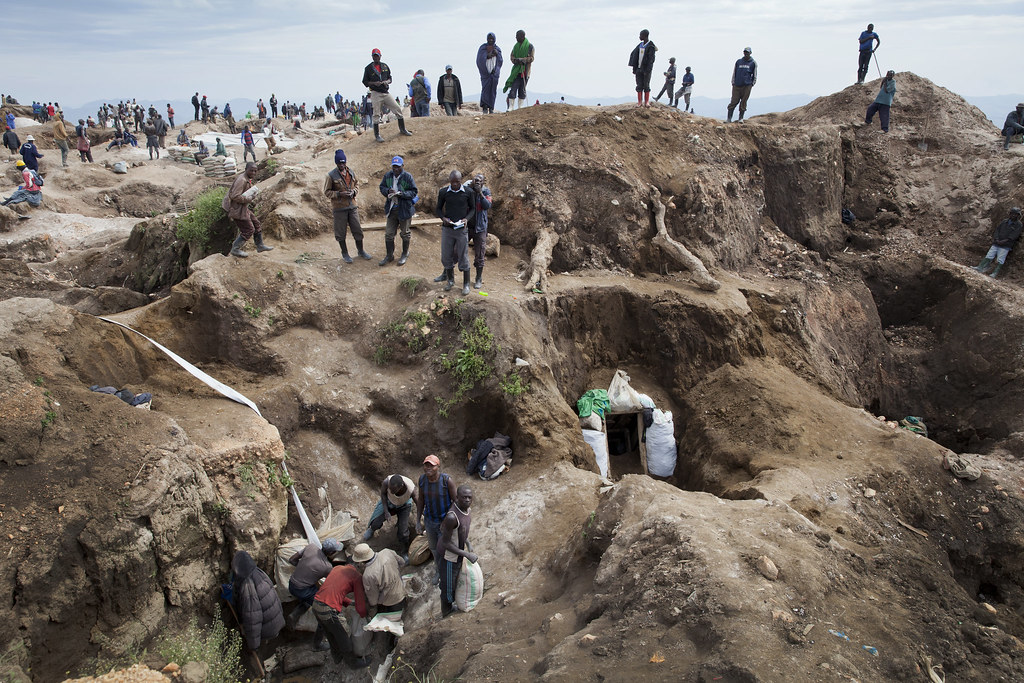
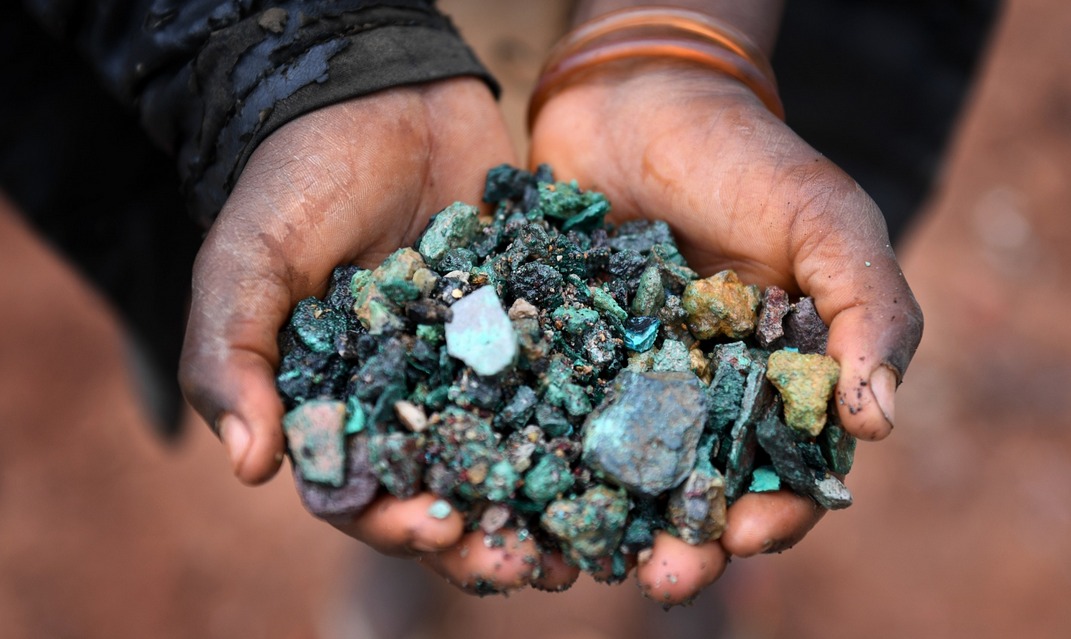
Photo credit: Mining Review Africa

Author: Joshua Woodend, Associate Researcher and Analyst, Governance and Economic Policy Centre

Abstract

Tanzania’s mining sector is central to national economic growth, contributing significantly to GDP and employment. However, the country’s reliance on foreign investment has bound its regulatory space to the constraints of international investment treaties. Bilateral investment treaties (BITs), in particular, grant expansive investor protections such as the ‘fair and equitable treatment’ standard, which often allow companies to challenge legislative reforms through costly arbitration. These mechanisms restrict Tanzania’s ability to implement necessary policies, including reforms aimed at increasing tax revenues, enhancing local employment, and addressing social and environmental concerns.

While reforms since 2010 have boosted government revenues and domestic benefits, they have also triggered arbitration claims, with Tanzania already paying over $100 million in related costs. To regain policy autonomy, Tanzania may consider terminating existing treaties, clarifying regulatory frameworks, and developing a model BIT with targeted carve-outs, thereby balancing investment promotion with sovereign control and sustainable development objectives.

Introduction

Tanzania’s mining sector is a major contributor to the nation’s economic development. Over the past decade, the industry has experienced steady growth, with mining projected to contribute 10% of GDP in 2025 (Ministry of Minerals, 2024). This significance is equally reflected in employment trends. A 2018 UNEP study estimated that the artisanal small-scale mining sector employed over a million Tanzanians, and in 2021, large scale mines were recorded to employ 14,742 people, significant figures for a nation of 60 million (Mutagwaba et al, 2018; Ministry of Minerals, 2024).

Tanzania’s mineral wealth has drawn substantial international investment, a trend actively encouraged by the government given the country’s limited capacity to exploit these resources without external capital. Consequently, as with many African nations, the mining industry is inexorably tied to foreign investment and ownership. The nation’s 2023 investment report on foreign private investments demonstrates this as mining and quarrying dominates FDI, being over 3 times larger than the second highest ranking sector, manufacturing (Bank of Tanzania, 2023).

For Tanzania, attracting international investment in the mining sector is a complex balancing act. On the one hand, the government must provide conditions favourable enough to persuade international mining companies to supply the capital needed to stimulate national growth and drive economic development. On the other hand, it is necessary to ensure these terms are not so generous that they undermine the government’s ability to control the mining sector, or that they provide conditions so favourable for foreign mining firms that there is no incentive to protect local people and retain some profits locally. This challenge is clearly reflected in Tanzania’s investment treaty regime.

What are investment treaties?

Investment treaties are agreements that define how a state treats foreign investors within its territory. Their scope is broad, encompassing a range of formats and parameters. Some are bilateral, covering investment flows between two states, such as the treaty between Tanzania and Finland. Others are multilateral, like the General Agreement on Tariffs and Trade (GATT), or regionally focused, such as the African Continental Free Trade Area. At present, Tanzania has 11 bilateral investment treaties in force, 7 treaties with investment provisions, is party to a range of multilateral intergovernmental agreements, and has also entered into an unknown number of privately negotiated investment agreements with large-scale investors (UNCTAD).

Whilst these treaties often succeed in creating favourable conditions for international companies investing in the mining sector, they also limit the government’s power to regulate this sector. This stems from the broad protections such agreements provide and the stringent enforcement mechanisms they enable. In particular, bilateral investment treaties (BITs) are especially known for constraining a nation’s ability to enact legislation changes, an especially contentious issue in Tanzania’s mining sector.

This is because the wording of BIT provisions is notoriously vague, leaving room for extremely broad interpretation. For example, all of Tanzania’s BITs include a provision guaranteeing the ‘fair and equitable treatment’ of investments. Whilst this may appear innocuous, it has often been interpreted to protect a business’s legitimate expectation of a stable regulatory environment. As a result, even necessary changes to the mining industry can breach these treaties, as the regulatory environment is no longer stable. This results in a process known as investment treaty arbitration, a legal mechanism that favours investors over governments, allows companies to bypass domestic legal systems, and, on average, costs respondent states $4.7 million USD in legal fees, before any damages are awarded (Hodgson, Kryvoi, and Hrcka, 2021).

The threat of arbitration, combined with the broad scope of BIT provisions, often enables international mining companies to protest any legislative changes, including those aimed at improving the well-being of local communities. For example, in Foresti v. South Africa (2007), an Italian mining company alleged South Africa had breached the FET clause of the South Africa-Italy BIT by introducing affirmative action legislation that required mining license owners to divest a percentage of shareholdings to historically disadvantaged South Africans (Poulsen, 2015). Whilst this legislation was obviously necessary to reduce apartheid era inequalities, was universally applied and non-discriminatory in its implementation, the FET provision presented a huge legislative hurdle and cost in its implementation.

Since the 1960’s Tanzania has signed a long list of Double Taxation Agreements and Bilateral Investment Treaties with different Countries.  Some of these have since been terminated while a number of these continue in force with their corresponding provisions having relative effect on the mining.

Table 1 – Tanzania’s BITs in force (Excluding Investment Related Instruments)
Tanzania’s BIT Obligations
TreatyDate of SignatureTermination ProtocolKey Provisions Relating to MiningStatus (Active/ terminated/ Renegotiated/  
Canada Tanzania BIT2013Contract is active indefinitely but can be terminated 10 years after signing (2023) with termination becoming effective one year after a notice is given. Select articles shall remain in force for 15 years after termination.Provides carve outs protecting the regulation of exhaustible natural resources provided such measures are not applied arbitrarilyActive
China Tanzania BIT2013Contract is active indefinitely but can be terminated 10 years after signing (2023) with termination becoming effective one year after a notice is given. Select articles shall remain in force for 10 years after termination.Provides carve outs for regulation protecting the environment, provided they are not applied arbitrarily.Active
Turkey Tanzania BIT2011Contract is active indefinitely but can be terminated 10 years after signing (2021) with termination becoming effective one year after a notice is given. Select articles shall remain in force for 10 years after termination.Whilst the treaty is not explicit on natural resources and mining, it applies to all investment, including mining. FET provisions are included by default and hugely limit domestic capacity to regulate mining.Active
Mauritius Tanzania BIT2009Contract is active indefinitely but can be terminated 10 years after signing (2019) with termination becoming effective one year after a notice is given. Select articles shall remain in force for 10 years after termination.Whilst the treaty is not explicit on natural resources and mining, it applies to all investment, including mining. FET provisions are included by default and hugely limit domestic capacity to regulate mining.Active
Switzerland Tanzania BIT2004Contract is active indefinitely but can be terminated 10 years after signing (2014) with termination becoming effective six months after a notice is given. Select articles shall remain in force for 10 years after termination.Whilst the treaty is not explicit on natural resources and mining, it applies to all investment, including mining. FET provisions are included by default and hugely limit domestic capacity to regulate mining.Active
Finland Tanzania BIT2001Contract is active indefinitely but can be terminated 10 years after signing (2011) with termination becoming effective one year after a notice is given. Select articles shall remain in force for 15 years after termination.Whilst the treaty is not explicit on natural resources and mining, it applies to all investment, including mining. FET provisions are included by default and hugely limit domestic capacity to regulate mining.Active
Italy Tanzania BIT2001Contract is active indefinitely but can be terminated 10 years after signing (2011) with termination becoming effective one year after a notice is given. All articles shall remain in force for 20 years after termination.Whilst the treaty is not explicit on natural resources and mining, it applies to all investment, including mining. FET provisions are included by default and hugely limit domestic capacity to regulate mining.Active
Denmark Tanzania BIT1999Contract is active indefinitely but can be terminated 10 years after signing (2009) with termination becoming effective one year after a notice is given. All articles shall remain in force for 10 years after termination.Whilst the treaty is not explicit on natural resources and mining, it applies to all investment, including mining. FET provisions are included by default and hugely limit domestic capacity to regulate mining.Active
Sweden Tanzania BIT1999Contract is active indefinitely but can be terminated 10 years after signing (2009) with termination becoming effective one year after a notice is given. Select articles shall remain in force for 15 years after termination.Whilst the treaty is not explicit on natural resources and mining, it applies to all investment, including mining. FET provisions are included by default and hugely limit domestic capacity to regulate mining.Active
United Kingdom Tanzania BIT1996Contract is active indefinitely but can be terminated 10 years after signing (2006) with termination becoming effective one year after a notice is given. All articles shall remain in force for 20 years after termination.Whilst the treaty is not explicit on natural resources and mining, it applies to all investment, including mining. FET provisions are included by default and hugely limit domestic capacity to regulate mining.Active
Germany Tanzania BIT1968Contract is active indefinitely but can be terminated 10 years after signing (1978) with termination becoming effective one year after a notice is given. Select articles shall remain in force for 20 years after termination.Whilst the treaty is not explicit on natural resources and mining, it applies to all investment, including mining. FET provisions are included by default and hugely limit domestic capacity to regulate mining.Active
Tanzania’s Treaties with Investment Provisions
TreatyDate of SignatureTermination ProtocolKey Provisions Relating to MiningStatus
African Continental Free Trade Area2018Contract is active indefinitely but can be terminated 5 years after entry into force (2023), with termination becoming effective two years after notice is given. Pending rights and obligations shall continue to apply despite termination.No obligations in the treaty prevents the enforcement of measures related to the importations and exportations of gold or silver, the conservation of exhaustible natural resources or exports of domestic materials necessary to ensure essential quantities of such materials to a domestic processing industry  Active
Trade Agreement Between the East African Community and United States of America2008Contract is active indefinitely but can be terminated at any point after signing, with termination becoming effective 180 days after notice is given. No survival clauses apply.Does not specify mining but is included under its remitActive
South African Development Community Protocol on Finance and Investment2006Contract is active indefinitely but can be terminated at any point, with termination becoming effective 12 months after notice is given. No survival clauses apply.States shall promote the use of their natural resources in a sustainable and an environmentally friendly manner; recognise that it is inappropriate to encourage investment by relaxing domestic health, safety or environmental measures; Nothing in this Annex shall be construed as preventing a State Party from exercising its right to regulate in the public interestActive
East African Community Treaty2000Contract is active indefinitely but can be terminated at any point, with termination becoming effective 12 months after notice is given. No survival clauses apply.Requires integration of environmental management in mining sector and the sustainable use of natural resourcesActive
The Treaty on Southern African Development Community1992Contract is active indefinitely but can be terminated at any point, with termination becoming effective 12 months after notice is given. No survival clauses apply.Mandates member states to cooperate in mining and natural resource sectors for purpose of regional developmentActive
Treaty Establishing the African Economic Community1991Contract is active indefinitely but can be terminated at any point, with termination becoming effective 12 months after notice is given. No survival clauses apply.Requires mutual cooperation on policy around natural resourcesActive
Impacts of Investment treaties on Tanzania’s mining sector regulation

The Tanzanian mining sector has been repeatedly constrained by treaty obligations, facing both threats and actual arbitration proceedings in response to reforms aimed at retaining greater value within the country. Notable measures include the Mining (Value Addition) Regulations of 2020, which require the use of local service providers and processing facilities; the Mining (Local Content) Regulations of 2018, which mandate the employment of Tanzanian nationals; and the Mining Act of 2010, which significantly increased royalty rates.

Whilst all these changes may violate investment treaty provisions, such as the ‘fair and equitable treatment’ standard, due to their radical nature, such efforts for reform are to be expected given the previous unfavourable legislative status quo that disadvantaged Tanzanian people. The scale of this disadvantage is stark: between 1997 and 2005, Tanzania exported over US $2.54 billion worth of gold yet collected merely 10% in tax revenue, a disparity that generated significant social tension (Curtis and Lissu, 2008; Noe, 2006). In 2015 Tanzania instituted significant mining reforms, including changes to the mining fiscal regime, increasing government stake and control of the mining sector.  For comparison, since Tanzania’s mining sector reforms, between 2023/24 alone, Tanzania raised over US $2.5 billion in tax revenue and massively increased the employment of local people (Ministry of Minerals, 2024).  These reforms triggered  investment disputes and led to costly arbitral awards.

Determining the precise financial cost of Tanzania’s mining regulation changes through investment arbitration fees and penalties is challenging. Through ICSID, a widely-used arbitration mechanism, Tanzania had by 2025 already paid over $100 million USD in fees for its legislative changes, specifically for cancelling retention licenses that had granted foreign mining companies pre-emptive rights to specific locations (UNCTAD, 2025).

However, this figure likely represents only a fraction of the total arbitration costs stemming from Tanzania’s mining policy reforms. Many BITs enable arbitration through mechanisms that operate without public disclosure requirements outside of ICSID, meaning the actual financial burden on the Tanzanian government may be substantially higher than publicly reported figures suggest.

Consequently, investment treaties significantly impact Tanzania’s capacity to introduce mining reforms by granting investors broad rights that enable litigation over even minor regulatory changes. The threat of compensation payments, combined with high arbitration costs, at best imposes a substantial financial burden on mining sector reform efforts, and at worst, creates powerful disincentives that discourage the government from proposing or implementing changes that improve local development. This can easily result in a regulatory environment that favours investors and foregoes significant taxation revenue that could benefit the nation at large, including those who are proximate to mining enterprises and it’s damaging effects.

Consequently, investment treaties constrain Tanzania’s capacity to reform its mining sector by granting investors expansive rights that allow them to litigate against even modest regulatory changes. While the immediate impact is the risk of substantial compensation awards and the heavy financial burden of arbitration proceedings, the implications extend further. Bilateral investment treaty provisions can lock in tax concessions or limit fiscal space, resulting in foregone revenues that could otherwise support national development. Equally, non-financial costs emerge: the prospect of diplomatic or political pressure, the withholding of aid, and negative media portrayals of Tanzania as a hostile investment destination. Together, these pressures can deter policymakers from pursuing reforms that prioritise domestic welfare over investor interests. In practice, this often produces a regulatory environment that privileges foreign mining companies at the expense of local communities and the state’s ability to capture taxation revenues.

Policy Recommendations

So, what can Tanzania do to remedy this situation? The most direct step would be to terminate its existing bilateral investment treaties, a move already taken by countries such as Ecuador, Bolivia, South Africa, Indonesia and India (Public Citizen, 2018). Yet this is far from a quick solution. As shown in table one, many of Tanzania’s treaties contain survival clauses that ensures provisions can be in force for up to 20 years after termination, this makes termination a necessary but inevitably long-term measure.

In the meantime, Tanzania must work to reduce perceptions of risk by presenting a clearer and more predictable regulatory environment. While past legal reforms in the mining sector have often appeared erratic, future changes should be grounded in transparent communication with stakeholders and shaped around consistent licensing and tax frameworks. This would build investor trust in the market, despite the lack of BITs, as they can rely on the government to act in rationale, legal manner, with space for negotiation.

Finally, Tanzania may invest in developing its own model BIT, complete with prudential carve-outs that reflect Tanzania’s development priorities. The development of such a treaty would allow the country to reassure investors of fair treatment while avoiding the loss of vital policy space.

Bibliography:

The Bank of Tanzania, The Tanzania Investment Centre and The National Bureau of

Statistics (2023). Tanzania Investment Report 2023 – Foreign Private Investments. Dar

es Salaam: Government of Tanzania.

Curtis, M. and Lissu, T. (2008). How Tanzania is Failing to Benefit from Gold Mining. Dar es Salaam: The Christian Council of Tanzania.

Hodgson, M., Kryvoi, Y. and Hrcka, D. (2021). 2021 Empirical Study: Costs, Damages and Duration in Investor-State Arbitration. London: British Institute of International and Comparative Law, Allen and Ovary.

Ministry of Minerals (2024). Investor’s Guide Tanzania Mining Sector 2024. Dar es Salaam: The Ministry of Minerals, pp.1–23.

Ministry of Minerals (2024). Ministry of Minerals – Republic of Tanzania. [online] Madini.go.tz. Available at: https://www.madini.go.tz/page/03cef72a-bdd3-41dc-ba84-40954095b835/.

Mutagwaba, W., Bosco Tindyebwa, J., Makanta, V., Kaballega, D. and Maeda, G. (2018). Artisanal and small-scale mining in Tanzania – Evidence to inform an ‘action dialogue’. London: International Institute for Environment and Development.

Noe, C. (2020) Graduated Sovereignty and Tanzania’s Mineral Sector. Utafiti. [Online] 14 (2), 257–280.

Poulsen, L. N. S. (2015) Bounded rationality and economic diplomacy: the politics of

investment treaties in developing countries / Lauge N. Skovgaard Poulsen (University

College London). Cambridge: Cambridge University Press.

Public Citizen (2018). Termination of Bilateral Investment Treaties Has Not Negatively

Affected Countries’ Foreign Direct Investment Inflows. Washington D.C: Public Citizen.

The Bank of Tanzania, The Tanzania Investment Centre and The National Bureau of Statistics (2023). Tanzania Investment Report 2023 – Foreign Private Investments. Dar es Salaam: Government of Tanzania.

UNCTAD (2022). The International Investment Treaty Regime and Climate Action | Publications | UNCTAD Investment Policy Hub. [online] Available at: https://investmentpolicy.unctad.org/publications/1269/the-international-investment-treaty-regime-and-climate-action

UNCTAD (2025). Tanzania, United Republic of | Investment Dispute Settlement Navigator  | UNCTAD Investment Policy Hub. [online] Unctad.org. Available at:
https://investmentpolicy.unctad.org/investment-dispute-settlement/country/222/united-republic-of-tanzania  [Accessed 17 September 2025].
Debt Budgets: A post budget political economy analysis of EAC Countries 2024/25 budget priorities, viabilities, risks and how governments can restore public confidence

Economists have always asserted that you know a country’s priorities from its budget while political scientists further suggest that a state and government’s health is reflected by the budget it makes and implements. In short, show us a good budget and we will show you a prosperous nation!

By Moses Kulaba, Gloria Shechambo, Robert Ssuuna, Dorine Irakoze, and Boboya James Edimond

Governance and Economic Policy Centre

@GEPC_TZ

The budget is an essential social contract that establishes the relationship between the government and its citizens, and the only one renewed annually, yet budget making in East Africa is becoming an exercise in futility.

This brief uses a political economy and trend analysis of the budget allocation priorities and estimates for 2023/4 and 2024/2025 as a basis to evaluate the extent to which East Africa Community (EAC) Countries budget policies and priorities are viable, fit into the local and global context but at the same time promote equity and reduce the economic burden on ordinary citizens.  We exposes the embedded risks, misalignments and further highlights the magnitude of the debt burden plaguing all EAC countries and its likely impact on budget viability and future macro-economic targets. We rekindle the need for an evaluation of budgeting processes in EAC, a revival of citizens participation in budgeting and repositioning the budget at the Centre for public policy. Our final conclusion is that there are malignant risks. Governments must budget better, tax wisely, address debt and strengthen public participation to revamp citizens confidence and trust in the national budget processes.

The 2024/25 Budget Context

The 2024/25 year’s budgeting was met with insurmountable obstacles and political economy pressures never anticipated before. East Africa is undergoing extreme budgetary pressures amidst a hectic political cycle. Governments are experiencing constantly, dwindling foreign aid, high indebtedness, a restless population, apathy to more taxation, ahead of a sensitive election period in many EAC Countries. The years 2024 to 2027 will be election years in Rwanda, South Sudan, Tanzania, Uganda and Kenya. 

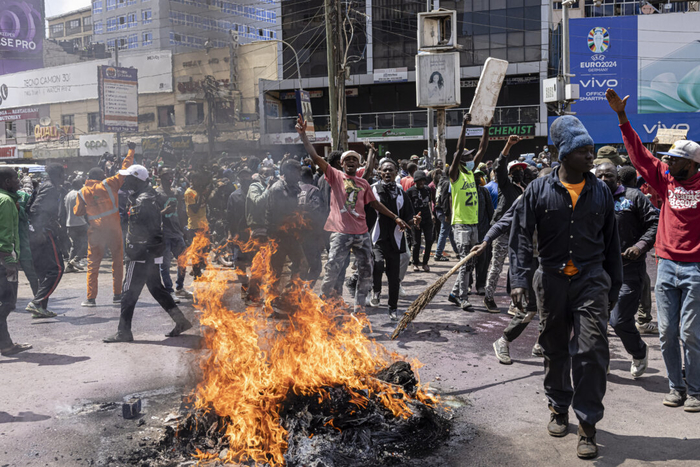
Normally election budgets tend to be quite generous as the incumbent regimes seeking re-election avoid taking drastic measures that alarm citizens and discourage their courted voters.   The 2024/25 financial year’s budgets however came at a time of increasing economic hardships, outcries over taxation, violent tax protests, a persistent global economic slowdown and jobless growth. This complicates the budget choices that governments can take and whether the desired budget goals can be achieved.

According to the Africa Development Bank, East Africa and Africa’s is expected to record an economic growth of 3.4% in 2024[1] but we project that this growth could be staggered by a myriad of externalities such as the ongoing tax protests, conflict, climate change hazards and a general slowdown in global economic growth.

Moreover, there is increasing uncertainty about the impact of the continuing Russia-Ukraine war and an escalating and endless Israel-Palestine war on the global economy by exerting political pressures and extracting resources away from development. Besides disruptions in international trade and commerce, the wars have devastating economic impacts on EAC country’s traditional donors such as the United States, the United Kingdom and the European Union.

These traditional donors are constrained with multiple domestic political, social and economic challenges to finance at home.  There is uncertainty about foreign policy shifts. For example, the outcomes of the United States (US) Presidential election may determine a major shift in US foreign policy and therefore the future US-Africa foreign policy cannot be guaranteed.

The European Union (EU) has witnessed a resurgence in nationalistic tendencies and drastic swing to the right with increasing demands for inward looking policies to secure Europe’s future. The EU faces huge political and social challenges such as immigration to tackle. All these constrain EU budgets for external aid assistance and their continued support for Africa is jeopardized.

Faced by such unpleasant realities, EAC governments are obliged to make national budgets that can realistically be achieved, balancing economic and political targets at the same time, while reducing the economic burdens on ordinary citizens. However, a quick review of the 2024/25 national budgets passed by EAC countries indicates that this year’s budgets were a major gamble and fumble. 

Some countries such as Kenya has already failed to pass the test.  Others muddled through however their expectations look ambitious, plans misaligned, over burdened with debt. Precisely, the political and economic budgeting terrain is quite murky and tenacious and end of year collection out turns for 2024/25 financial may never be achieved.  

Yet in recent years, the budget exercise has become of less interest to ordinary citizens, viewed as quite top-down executive driven exercise, led by technocrats with less consideration of citizens views[2]. Questions are asked how can governments in the future balance between political and economic expediency, debt financing and development most significantly restore public confidence in the budget process as means of raising legitimate public money and delivering public goods. In this analysis, we explore and share commentary perspectives to answer this question and what citizens and governments can do.

Aligning EAC Budgeting to Regional and Global Context

The regional and global economic trajectory and potential outlook shows a zig zag pattern or mixed bag of hits and misses.  Globally there are signs of a general economic slowdown and inequitable growth. 

According to the OECD’s latest Economic Outlook, the global economy is continuing to growing at a modest pace, The Economic Outlook projects steady global GDP growth of 3.1% in 2024, the same as the 3.1% in 2023, followed by a slight pick-up to 3.2% in 2025[3]. The International Monetary Fund (IMF) baseline forecasts the world economy to continue growing at 3.2 percent during 2024 and 2025, at the same pace as in 2023. The IMF notes that a slight acceleration for advanced economies—where growth is expected to rise from 1.6 percent in 2023 to 1.7 percent in 2024 and 1.8 percent in 2025—will be offset by a modest slowdown in emerging market and developing economies from 4.3 percent in 2023 to 4.2 percent in both 2024 and 2025. The forecast for global growth five years from now—at 3.1 percent—is at its lowest in decades[4]. Even some spikes of growth in some insular countries such as Rwanda, Senegal and regions like Asia will not catapult the global economies to the desired targets of about 7% consistent economic growth over the next three years.

Moreover, multiple reports indicate that over 60% of Africa’s GDP is spent on debt serving and this significantly affects resources available to spend on development and real economic growth. According to the Economic Commission for Africa, the average debt-to-GDP ratio for the entire continent was projected to rise to 63.5% in 2023. The Commission warns that escalating debt levels in Africa are prompting concerns that repayment may not only constrain economic performance but could become virtually impossible for many African countries.

The AfrexExim Bank reports that Africa’s debt burden has grown significantly in the past 15 years surging by 39.3 percentage points between 2008 and 2023, resting at 68.6% of GDP in 2023[5].  At the current interest rates, less developed countries will never wean themselves off external debt and many countries defaulting in the near future is real.

The EAC governments therefore need to be extremely cautious and trend with maximum care on the economic their targets and priorities they make. The following guard rails are essential must be considered in advance planning of the budgets in the current obtaining and foreseeable context.

  • Avoid over taxation and stifling of nascent businesses by taking a precautionary facilitative approach verses ambitious revenue collection targets. Spare disposable incomes in the pockets of citizens and small business could stimulate both consumption, production and growth
  • Addressing economic stagnation, inflationary pressures and jobless growth
  • Addressing climate change and transition to clean energy by encouraging investment and financing of green businesses
  • Harnessing natural resources such as critical minerals to maximize benefits and revenues during the current and future envisaged boom
  • Weaning off the exorbitant external debt pressures and addressing persistent distortions in the global financial lending architecture
  • Designing and setting of long-term goals and tax policies which can drive politics, investment and trade into the future
  • Funding agriculture to support food security, create jobs and agriculture-based industrialization and value addition

An analysis of the budget statements indicates that these critical elements were largely missed by many governments’ economic planners. The net effect of the year’s (2024/25) budget processes is that the midterm and long-term targets in most EAC countries may never be fully gained and economic hardships could remain a persistent future moving forward.

Summary Analysis of EAC Countries Budget Priorities: A detailed Country Analysis of each is available via: xxx

Country Budget Allocation Summary Commentary
Tanzania Allocated Tsh49.35 Tln . Prioritized debt servicing (27%) and infrastructure (11%) with moderate funding of social-economic development sectors. Sectors such as Preoccupied on financing legacy infrastructure projects and continuity, missed revenue targets by 2% over the last two years raising concerns over budget sustainability. Limited citizen participation and budget reliability and credibility of have been flagged by studies and development partners under the FISCUS PEFA report 2022.
Uganda Allocated a budget of Ush72.139 Tln up from up from an initial Ush 58.34Tln (increase of Shs14.050 trillion) proposed in May 2024 and Shs 52.74 Tln in the financial year 2023/24, representing a 36% increase over the last year’s resource envelope. Debt servicing accounts for 57.8% of the total budget allocation with Human Development following at a paltry 14% A quite ambitious budget, overtaking Tanzania’s total budget allocation for the first time in history. Given the economic growth, missed revenue targets and tax protests, it is not clear how those resources will be raised. Moreover, wide spread corruption and over expenditure on political organs and projects has raised concerns, reducing credibility and interest among citizens.
Rwanda For the fiscal year 2024/25 Rwanda passed a budget of Frw 5,690.1 billion (USD4.3bln). Has prioritized Economic transformation pillar (59.6%), social transformation (26.6%) and Transformational Governance (13.8%) Despite stellar economic performance, Rwanda faces constant external threats such as the war in the neighboring DRC and a tainted image from UN accusations of Rwanda as a regional destabilizer.  Over reliance on agriculture is a risk too.
Burundi Allocated 4.4 trillion Burundi francs ($1.5 billion) in the 2024/25 representing an increase of 15% from previous years. Prioritised funding public service and agriculture. Public debt rose from 68.4% of GDP in 2022 to 72.7% in 2023.Has an international credibility issue to regain. Opportunities in Burundi’s critical minerals sector could offer a major breakthrough.
Democratic Republic of Congo (DRC) 2024 budget data is scanty, reports indicate DRC prioritized funding defense against the war in the Eastern Part of DRC and public service. Social development sectors and infrastructure are still underfunded DRC Faces serious instability in the East, and public management challenges, a debt problem. Potential from its mineral wealth but a risk of expensive resource backed loans is real
South Sudan Failed to pass the 2024/2025 national budget. In the FY 2023/2024, allocated a budget of South Sudanese Pounds2.105 trillion (USD1.32bln). Prioritized infrastructure (22%). Other social development sectors took less than 10% each. South Sudan has a huge external debt estimated at over USD $ 2,051,335,901 The government’s petroleum revenues have suffered from the ongoing conflict in Sudan, stifling its economy and ability to raise revenue. Many public servants and essential social delivery are yet to be paid. The ongoing conflict amidst reports of corruption and a huge national debt will affect the country’s future economic possibilities.
Kenya Failed to pass a budget of Ksh3.99Tln    and reverted to using the Finance Bill 2023 to raise revenue. The country has witnessed wide spread violent tax protests, forcing the government to backdown on major tax measures.  The government is under siege and not able to tax. With a bludgeoning external debt, a government under siege and restless population opposed to more taxation, Kenya’s economy is at its weakest.  Kenya was downgraded to Junk status making it more expensive to borrow and raise external capital.  A risk of an economic meltdown is real.

Risks to EAC Countries National Budget Priorities, Viability and Success

In the final Analysis we identify the following risks to the 2024/25 budgets and budgeting generally in  East Africa

Debt Risk: Huge public debt risk is real and if unchecked will literary transform EAC governments into debt collectors on behalf of their lenders. At the current rates, over 50-60% of tax collected by EAC governments in the next 2-3 years will be spent on debt servicing, effectively locking the region into a permanent cycle of debt payment and slow progress. As observed by Uganda’s legislator, Hon Semuju Nganda, “Next financial year (2024/25) Uganda will spend Shs 34 trillion (close to half) on debt servicing  and yet the country thinks it is processing a budget.” The debt risk is significant.

Political and Democracy risks.  Politics and governance in EAC are driven with political alliances and favoritism.  As governments head towards elections there is an increased risk of proposing ambitious budgets that are unviable and could be misaligned with citizens demands. Moreover, large proportions of the budget are being spent on politicians (large cabinets, large parliaments, political advisors, Governors, MCAs etc) and political enterprises such as subsiding political parties. Political parties with representation in parliament have become state enterprises funded by public resources. This is a risk

Credibility risks– The national budgets are losing credibility as statements of macroeconomic policy and social contracts between the governments and citizens. Citizens are increasingly getting detached from the budget with stronger perceptions that their views do not matter- The tendency is never to understand government incentives and plans. If unaddressed will drive constant apathy and resistance against taxation and revenue collection strangling public expenditure.

Economic growth and equity risks: Caused by among others persistent jobless growth, misaligned priorities, unfulfilled earlier economic promises, global economic slowdown and shifting economic policies that may have significant impacts on the EAC countries and region’s growth. The risk is that Budgets may not create tangible economic impacts on ordinary people.

Conflict and Distress risks- This risk is aggravated by the ongoing internal protests against taxation and civil wars such as in the ones in Somalia, Sudan, South Sudan and the DRC. The risk is that available resources will continue being channeled towards war. Further, the international conflicts such as the Ukraine-Russia war will disrupt global supply chains of essential such as grain and redefine geo-economics’ alignments affecting volumes and direction flow of supportive development linkages to the EAC Countries.

Climate Risks: Unpredictability of whether patterns affecting heavily agricultural reliant countries and economies such as Burundi, Uganda and Rwanda. Affecting food supplies and foreign revenues from agricultural sources.

Corruption and Public Management risk– Rising opulence and failure to tame corruption, place and enforce guard rails to mismanagement of public expenditure, exacerbating resistances or rebellion against taxation and budgets generally.

Forward looking, Restoring National Budget Credibility and Public Confidence

  1. Develop and pass realistic national budgets with less ambitious and white elephant projects to be funded in the next few years
  2. Leverage on existing natural resources such as critical minerals and the abundant blue economy as new levers to driver the economy further
  3. Mitigate expectations of large streams revenues from fossil-based projects such as Oil and Gas, factoring in the climate change global pressure to decarbonize and how this could impact on fossil-based revenues in the future
  4. Repurpose investment in young people (the Gen-Z) with jobs created in non-traditional fields and professions such as technology, e-commerce, content creation and redistribution of economic opportunities and wealth beyond the political class
  5. Re-channel heavy investment into agriculture, as a ‘go back to basics’of agriculture as the backbone of our economies, given its potential and ability to cushion other sectors of the economy, including providing food security and incomes to millions of citizens. Remember a hungry person will always be an angry person. Addressing agriculture and food constraints can radically address the spiraling costs of living and desperation that we are currently experiencing in the region.
  6. Tax rationally, modestly, and spend less on nugatory public finance expenditures, tame corruption and malfeasance of public resources. Clearly punish the corrupt and reward the best performers.
  7. Ramp up a global campaign against debt and reform the shylock global lending system which is designed to largely constrain and drain more resources from less developed countries. 
  8. Avoid mistakes in Tax policy and administration that we experienced this year. Be consultative, listen to the views and concerns of stakeholders with mutual respect and consideration. No one wants more demonstrations and violent tax protests next year.


NB: The full policy brief and individual country analysis reports for Tanzania, Uganda, Kenya, DRC, Rwanda, Burundi and South Sudan  will be published soon


[1] https://www.afdb.org/en/news-and-events/press-releases/41-african-countries-set-stronger-growth-2024-keeping-continent-second-fastest-growing-region-world-african-development-banks-economic-outlook-71384

[2] https://theconversation.com/kenya-protests-show-citizens-dont-trust-government-with-their-tax-money-can-ruto-make-a-meaningful-new-deal-234008

[3] https://www.oecd.org/newsroom/economic-outlook-steady-global-growth-expected-for-2024-and-2025.htm#:~:text=The%20global%20economy%20is%20continuing,up%20to%203.2%25%20in%202025.

[4] https://www.imf.org/en/Publications/WEO/Issues/2024/04/16/world-economic-outlook-april-2024

[5] https://media.afreximbank.com/afrexim/State-of-Play-of-Debt-Burden-in-Africa-2024-Debt-Dynamics-and-Mounting-Vulnerability.pdf

Political Risk and Investment in EA: An Expose of violent tax protests and political risk on Trade and Investment in East Africa

In our previous brief on Tax and Fiscal governance in East Africa, we observed that with dwindling foreign aid, it appears the governments in East Africa have resorted to squeezing everywhere to raise some dime.  We cautioned that Taxation may be good however, when the extremes are beyond reasonableness, governments are bound to break their break the back of the economies they aspire to build[1]. The recent and ongoing tax protests that have rocked the East African regions, with violence and vandalism spiraling out of control in Kenya, clearly underscore this point. A failed tax administration and an irate society.

By Moses Kulaba, Governance and Economic Policy Centre

@taxjustice @politicalrisk

Freedom of expression, the right to picket and demonstrate and resist punitive taxation has been established over the years.  The doctrine of no taxation without proper representation was long established by the Romans, Greeks and Americans during the famous Boston Tea Party 1773) and American war of independence, The French Revolution and the English, paving way into the famous Magna Carta.

This was further advanced by Adam Smith in his legendary Canons of Taxation asserting that generally, a good tax system must be underlined by proportionality and ability to pay[2] and political scientist Harold D Laswell’s tax law of who pays, what and when, and each individual or group should “pay their fair share. These principles that tax liability should be based on the taxpayer’s ability to pay is accepted in most countries as one of the bases of a socially just tax system and generally citizens are duty bound to reject a system that is regarded as unfair and disproportionally beyond their means[3].

However, when peaceful protests and demonstrations strategically drift towards violence, vandalism and murder like the ones we saw in Kenya, then these effectively transform into high level political risks to trade and investment.

According to multiple sources a political risk is a type of risk faced by investors, corporations, and governments that political decisions, events, or conditions will significantly affect the profitability of a business actor or the expected value of a given economic action. In simple terms, a political risk is the possibility that your business could suffer because of instability or political changes in a country: conflicts and unrest, changes in regime or government, changes in international policies or relations between countries, as well as changes that occur in a country’s policies, business laws or investment regulations[4]. Examples of political risks include; unilateral state decisions, war, terrorism, and civil unrest

By their nature, these risks are expensive to be insured against and constitute a major determinant factor for business in deciding where to invest or do business. Highly political risk countries experience sharp declines in investment and may attract low new trade and investments flows.

According to Trade and Investment experts such as Pierre Lamourelle, Deputy Global Head of Specialty Credit within Allianz Trade for Multinationals, the interconnected nature of the global economy makes it very possible that a political risk in one country may affect many businesses across the globe.

“What has changed in the 25 years since I started in this business is that we are living in a more connected world today,” says Pierre. On the upside, that means business is easier to conduct on a global scale. Almost everybody now has the ability to reach out to emerging countries or to conclude a contract and secure a sale in a foreign country.

On the downside, this means that when something goes wrong in one part of the world, you can feel the impact halfway around the globe – directly, if you are dealing with the country in question, or indirectly because of your diverse supply chain. Remember when the 20,000-ton container ship “Ever Given” got stuck in the Suez Canal in March 2021, shutting down international trade for a week?

In today’s increasingly interconnected world, “just-in-time” supply chains, global internet connection, and smartphones give SMEs the ability to conduct business in a global arena. This means the possibility for great opportunities, but also that every business is just steps away from political risk.

Persistent violent tax protests can make it difficult and unpredictable for the government to raise enough tax revenue to finance its obligations, including servicing of sovereign commitments such as paying off its debts and makes the economic environment very unpredictable. This can lead  global economic and financial institutions to flag or down grade the Country’s economic status as risky , making difficult and more expensive for the country and companies to raise external capital for investment.

Moreover, the violent protests occurred or are happening at a critical period of the year when East African Countries such as Kenya record the highest number of tourist arrivals into the Country for the summer holiday. Before the protests, national parks, hotels and beaches in Kenya’s tourist hot spots had already recorded high tourist bookings and were expecting a bumper harvest this season as the global economies and travelers rebound from the COVID 19 lock down.  Reports from multiple travel agents and hoteliers already indicate that most tourists have either cancelled or postponed their decisions to travel to Kenya and East Africa generally. Indeed, some already in the Country were gripped with fear of uncertainty and have left.

The burning image of an old plane at Uhuru Park did not send a good image either as most people around the world, unfamiliar with Kenya, thought Jomo Kenyatta International Airport was attacked and planes on the tarmac set on fire.  A recorded video clip that trended on social media of passengers crammed up at JKIA with a voice note indicating that many were fleeing the country added salt to the pinch suggesting Kenya was not safe anymore!

Similarly, travel advisories have been issued to foreigners in country and intending to travel to Kenya, to do that if it is essential and be vigilant of their security as safety during this violent period cannot be guaranteed. With all these at play, Kenya may remain a blacklisted destination among some foreign tourists for some period to come, denying the country the much-needed foreign revenue and jobs in its service sector. At least a number of high conferences that were planned for Nairobi were cancelled.

The net effects of the demonstrations therefore go beyond having the bill rejected but have long-term economic effects on Kenya’s economy. The violent Gen-Z’s may have to reconsider their approach to avoid a full economic meltdown.

Of course, there are legitimate concerns that some current established large business and investments were already not providing benefits to the young people. Multiple reports have shown that some businesses were tax dodgers while others belong to the politically connected who used their political connections to shove deals and amassing wealth on the backbone of the majority Kenyans. Moreover, given the current loopholes in the governance systems, new trade and investment opportunities would not support or create many new economic opportunities either.

However, when these arguments are advanced, it is also imperative to look at the broader picture of the net effect that violent protests can have on Kenya’s economy and future that the Gen-Z seeks to address. Kenya’s economy is extensively connected and dependent on the global economy with most global business having chosen Nairobi as a regional financial hub.  Violent demonstrations and disruption of such a magnitude can have significant long-term impacts.

With a government under siege and  constrained with a debt tinkering on the margins of default and  unrelenting rancorous youth roaming and burning the streets of Nairobi armed with negative social media, Kenya’s economy could slide into a free fall and recession, whose impacts on everyone could be far reaching.

Taxation and a strong tax system may contribute to improved governance through 3 maximum channels. Taxation establishes a fiscal social contract between citizens and the taxing state. Tax payers have a legitimate cause to expect something in return for paying taxes and are more likely to hold their governments to account. Governments have a stronger incentive to promote economic growth when they are dependent on fair taxes.

In this regard, we suggest the following;

  1. Resistance demonstrations and protests for tax rights must be expressed with limitations and restraint from both sides- The state and citizens alike
  1. Government must be rational when imposing taxes. Tax policies must be clear and predictable.  Clearly, imposing taxes on bread and blanket exemption of choppers is a sign missed priorities.
  1. Government communication apparatus must be robust enough to explain to the citizens the justifications for taxation and the political class must lead by example demonstrating frugality in public expenditure.
  1. There must be distinction between private, public and national critical infrastructure, whose destruction may or can affect Kenya’s national security interest and state existence. Lest we forget, Kenya has been a victim of terrorism and still faces extensive threats from both internal and external elements, whose interests to harm Kenya has never wavered. Attacks on its critical infrastructure exposes the Country and Kenyans further to major threats.
  1. Re-engineering of Kenya’s governance and economy to address the contemporary needs for the Gen-Z. Times have changed and the Gen-Z who now constitute an overwhelming majority will effectively from 2027 be forever a major determinant of East Africa’s political future. Women will no longer be a game changer in electoral politics and outcomes but the Gen-Z will be.
  1. There is need for both political and social sobriety. East Africa needs good leadership and peace!

[1] Tax and Fiscal Governance: Is VAT milking the broken tax cow dry? An analysis of tax trends and impacts on EAC small traders, with a case of the recent traders’ demonstrations and boycotts in Uganda:

[2] Adam Smith, in his book, The Wealth of Nations, 1776

[3] Schronharl, K,  etal; Histories of Tax Evasion , Avoidance and Resistance; https://library.oapen.org/bitstream/id/346cfc5f-6001-40e3-8a3b-fe46405df8c2/9781000823882.pdf

[4] https://www.allianz-trade.com/en_US/insights/what-is-political-risk.html#:~:text=Political%20risk%20is%20the%20possibility,country’s%20policies%2C%20business%20laws%20or

Tax and Fiscal Governance: Is VAT milking the broken tax cow dry? An analysis of tax trends and impacts on EAC small traders and citizens, with a case of the recent traders’ boycotts in Uganda

With dwindling foreign aid, it appears the governments in East Africa have resorted to squeezing everywhere to raise some dime. Taxation may be good however, when the extremes are beyond reasonableness, countries are bound to break the back of the economies they aspire to build. Could the recent demonstrations in Kampala show a mismatch of tax policy and that the tax cow may be now broken or is it a case of misunderstanding of the tax system and the dividends of taxation?

By Robert Ssuuna, Researcher, Trainer, and Consultant,

Governance and Economic Policy Centre

@ Tax policy @ Tax justice @africataxproffessionals @fiscalgovernance

KAMPALA, UGANDA – APRIL 17TH 2018.
People go about their everyday business in Kikuubo, one of Kampala’s busiest trading areas.

Recently media in Uganda has been inundated by the stand-off between the Government and traders in the Central Business District of Kampala’s Capital Uganda locally known as Kikuubo with traders choosing to close shops in protest. The protest which later spread to other cities like Jinja, Mityana, and Masaka was triggered by the implementation of the Electronic Fiscal Receipt and Invoicing System (EFRIS) by the Uganda Revenue Authority.

According to the Taxman, the solution is intended to address concerns related to Value Added Tax (VAT) fraud.  VAT is known as an indirect tax charged by businesses at each stage of the production and distribution chain up to the retail stage of goods and services. VAT was introduced in 1996 replacing the sales tax and has since proved a reliable source of revenue contributing 30% of Total Tax Revenues on average and 4.4% of GDP[1]. To understand how well the VAT regime is managed in the country we use two main metrics, these are;-

  • VAT productivity which is the VAT revenue yield to GDP divided by the nominal VAT tax rate. VAT productivity measures how much each percentage point of the standard VAT rate collects in terms of GDP as given by the following ratio.
  • VAT Productivity= VAT Revenue/ GDP (Standard VAT rate)
  • VAT C-Efficiency which measures the VAT revenue performance and overall efficiency of the VAT system in an economy. The efficiency ratio is given by VAT revenue yield to the approximated proxy (Final Consumption) divided by the VAT tax rat It follows that, if VAT compliance was perfect, actual revenue over potential revenue, would be one. C-efficiency ratio is given as:- 
  • VAT-C Efficiency = Actual VAT revenue/(Final Consumption)(Standard VAT Rate)

Where actual VAT Revenue implies Total VAT collections less VAT refunds.

Using the above indicators,  we establish that in 2023 Uganda registered VAT productivity of   22%  while the VAT C-efficiency ratio  stood at 21% way below the African averages of 27.6% and 37.8% respectively (ATO, 2023)

Lower VAT productivity and C-Efficiency ratios imply a higher difference between real and declared revenues and consequently few economic agents meet their VAT obligations.

From the simple results indicated above, one might argue that the Government is justified to institute both policy and administrative mechanisms to address the low VAT productivity and VAT C- efficiency. One such intervention is the introduction of the EFRIS.

The system manages business transactions, tracks stock movements, automatically applies VAT-inclusive taxes (which directly affect informal traders’ profits), issues precise and traceable invoices, and promptly reports sales data to the revenue authority in real time. Through automated cross-checks the URA can more effectively match buyer and seller invoices, thereby preventing taxpayers from claiming input VAT credits without corresponding reports from sellers. Theoretically, this system tackles tax evasion in two main ways: Firstly, by creating a more accurate digital trail, it enhances URA’s monitoring capabilities and raises the likelihood of detecting evasion. Secondly, by offering clearer transaction records and facilitating pre-filled tax returns, it encourages voluntary compliance by simplifying the tax filing process. So one wonders why traders and the Government fail to agree on such a solution given the associated benefits.

From the informal trader’s perspective,  EFRIS exposes them to the risk of “premature formalization,” where their tax compliance costs, including penalties for non-compliance, escalate faster than any benefits gained from their efforts to sustain themselves. Traders believe that any measure that decreases the amount of money they have to spend freely is essentially a tax.

The challenges posed by the EFRIS system stem from concerns about reduced incomes caused by lower sales due to increased prices resulting from VAT on purchases made by informal sector operators, particularly Kikubo Traders, from formal sector operators. Additionally, there’s a decrease in income from their imports. These worries are intensified by URA’s strict enforcement tactics and the looming possibility of facing full taxation scrutiny from tax authorities. Critical issues associated with EFRIS are:-

First, is the general lack of awareness among the trading community on what EFRIS is,  its objectives, benefits, and associated challenges despite URA’s investment in taxpayer education since 2021 when the solution was rolled out.  It is no surprise that some traders regard this as another tax. Some of the traders also clearly seem not aware of how the VAT mechanism operates especially the Input versus output approach.

The second factor is the mode of implementation and per-requisites for the EFRIS. Traders are worried about the costs associated with  EFRIS. These include among others, hiring accountants or at least personnel with electronic numerical literacy, purchase of software, internet, purchase of the EFRIS gadgets, etc. Although all these are allowable expenses under the Income Tax Act, in the medium term they eat into traders’ working capital. To curtail these, the EFRIS regulations prescribe penalties for non-issuance of receipts generated by EFRIS and nonuse of EFRIS gadgets. The penalties are from UGX 6,000,000 and  UGX 8,000,000 respectively ( USD1700&USD 2200).

Third, is the VAT threshold. Currently, EFRIS is a requirement for only VAT-registered taxpayers with annual gross sales of UGX 150,000,000 (USD 42000).  The initial registration threshold was set at shs.20 million, and then increased to shs.50 million in November 1996, following a strike by traders. The threshold was further increased to shs.150 million in 2015, and it was argued, that including small businesses in the tax net by setting a very low VAT registration threshold can drain the limited resources available to the tax authority for administration, and yet the revenue potential is insignificant because of the low turnover and low-value addition. This is because VAT tends to impose high compliance costs on small informal traders who generally do not have sufficient resources to keep proper records of their transactions and comply with accounting rules.

With the depreciation of the UGX against the dollar since 2015, traders argue that the VAT registration threshold should be increased at least to UGX 1Bn to reflect current economic trends. Traders are also concerned that non-VAT qualifying suppliers are being denied by large supermarkets and departmental stores if they do not prove adherence to EFRIS requirements. This locks small-scale traders out of the supply chain affecting their earnings.

Finally, we note that traders are using the demonstration on EFRIS to buttress other perennial issues affecting their operations and contributing to taxpayer apathy. These include unclear application of import duties and valuation for used clothing (a blend of advalorem and specific duties), protracted VAT refund processes, general poor public service delivery, and glaring corruption scandals by politically exposed persons.

It must however be noted that the issue of VAT has been a concern of small traders across the East African Member states. The recent Ugandan demonstrations perhaps are a manifestation of the weaknesses and challenges of Tax policy and administration across the region.VAT is generally considered a regressive tax and one whose implementation has always been a source of concern and perhaps should be evaluated. 

VAT protest trends across East Africa

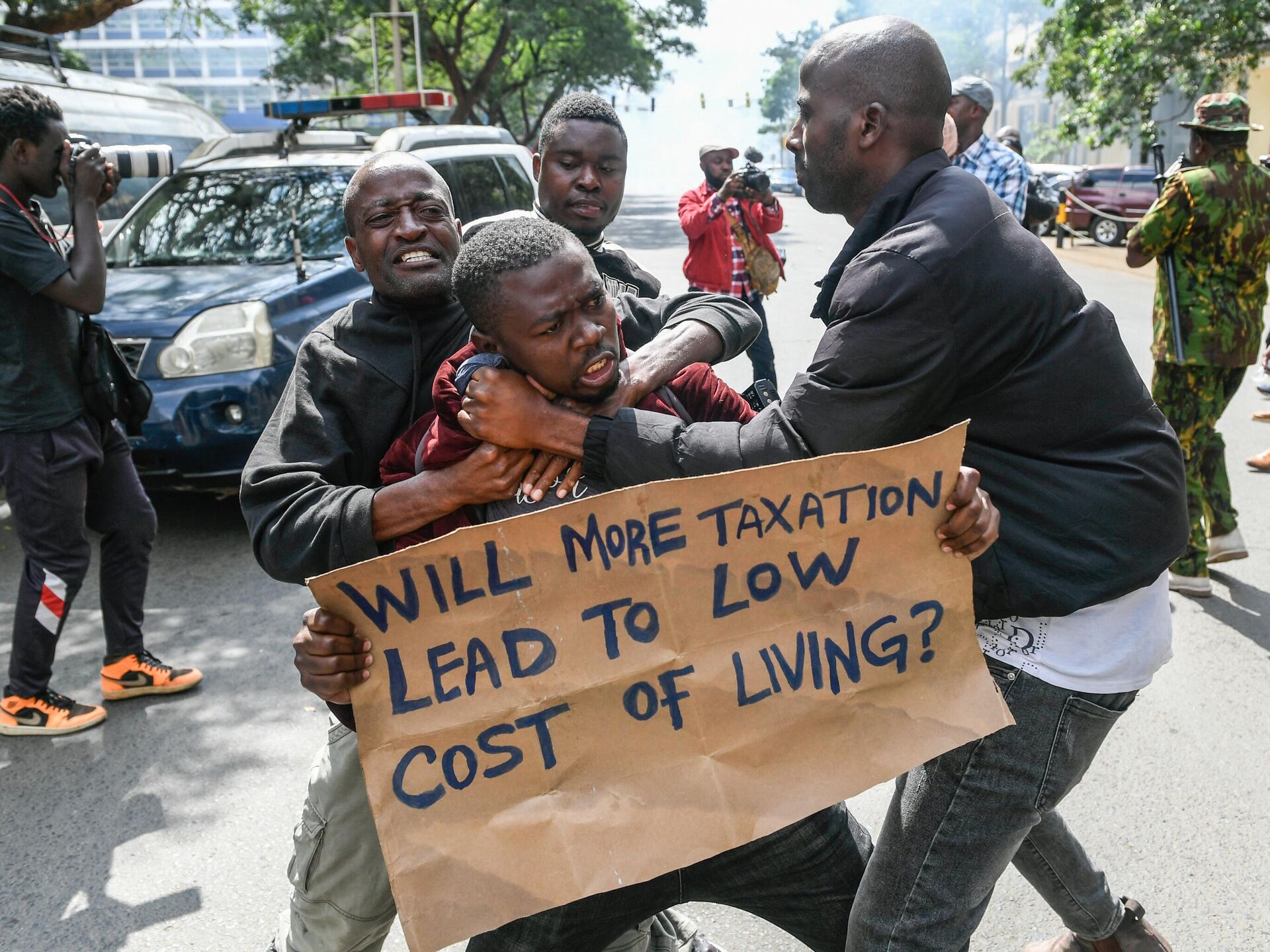
A man protesting Kenya’s Finance Bill 2023 is tackled by security outside Kenya’s Parliamentary Buildings in Nairobi, June 13th 2023. Courtesy Photo-Bizina

The litany of small traders’ strikes started last year (May 2023)  in Tanzania when the traders in Kariakoo, Tanzania’s, and perhaps East, Central, and Southern Africa’s largest commercial hub locked up their shops in protest over what was considered as taxation. Among the multiple taxes and levies protested was VAT. The traders wanted this reduced to 16% among others.   This later picked momentum with strikes and protests in Kenya, when the government proposed in its 2023 Finance Bill to increase the VAT, particularly on fuel products from an earlier 8% to 16%. To date, the Kenyan business community is not happy with this increase and has been complaining that a higher VAT increases the costs of living to the citizens,  doing business in Kenya and is detrimental to Kenya’s industrialization agenda.

In its 2024 Finance Bill,  the Kenyan government has proposed to introduce VAT on bread, which is largely viewed as a staple breakfast food for Kenyans.  If the proposal sails through parliament, bread, which is currently on a list of items that are zero-rated for VAT purposes— including flour, milk, and sanitary products— will attract the 16 percent tax that will see the commodity increase by at least Sh10 for 400-gram loaf. The government argues that levying bread with VAT is necessary because its zero rating was misplaced since it benefits the middle class who shop in supermarkets rather than the targeted low-income households.

Kenyans are generally not happy with this and if it is passed there could be another round of protests from different sections of what is already considered an ‘over-taxed’ Kenyan taxpayer.

Therefore the following measures should be taken to ensure that the Governments continue to milk the cow without breaking it,

  1. Invest in Taxpayer education and awareness should be a continuous process
  2. Improve accountability for the use of taxpayer money by improving the quality of public services and apprehending the corrupt to encourage voluntary compliance.
  3. Improve tax administrative efficiencies by continuously equipping URA staff with skills and ensuring that the staff numbers are adequate to manage the tax register.
  4. When introducing new systems such as EFRIS, tax administration should invest in reasonably wider consultation and ensure the participation of all those likely to be affected by the system from the design stage.
  5. Invest in agricultural commercialization, productivity, and industrialization to ensure that the majority of the agricultural sector actors are within the money economy to broaden the tax base.
  6. The government must develop a proper Tax policy to guide taxation and predictability of tax administration


Forthcoming Expert Webinar on Taxation and Tax Policy in East Africa

To discuss  and dissect this further we have organised an expert webinar on this subject will be coming up on the 30th May, 2024.  Please register to attend via the links below:

Title: Tax and Fiscal Governance: Is VAT milking the broken tax cow dry? An analysis of tax trends and impacts on small traders and citizens in EAC

Date: 30th May, 2024

Time: 11:00 AM to 12:30 PM EAT/ 10AMCAT
 
Meeting ID: 857 8760 2335
Passcode: 897276

[1] Author computation based on Revenue Statistics from the URA

How EAC can benefit from its Critical or Transitional Minerals

The EAC has vast deposits of minerals critical to driving technology to support the green industrial revolution and yet the region lacks a proper framework to govern and maximize benefit from this mineral potential.  Our analysis shows that all is not lost. There is still an opportunity for the EAC to reorganize and take a share from the increasing critical or transitional minerals demand.

By Moses Kulaba, Governance and Economic Policy Center

@critical minerals @mineralsgovernance @eac 

What is the EAC’s regional problem?

Critical or transitional minerals are loosely defined as mineral commodities that have important uses to industrial technology to support the transition to a clean energy future, have no viable substitutes, yet face potential disruption in supply. These minerals include (but limited to); Graphite, Coltan, Nickel, Tungsten, Tantalum, Tin, Lithium, Manganese, Magnesium, palladium, Platinum, Beryllium, copper, fluorspar, Holmium Niobium, Rhodium, Titanium, Zinc etc. The EAC has vast deposits of some these and yet the region lacks a proper framework to govern and maximize benefit from this mineral potential.

Minerals as a national resource vs regional resource

The issue of mineral is politically sensitive. It lies at the intersection of national pride and sovereignty. Minerals are considered as a national resource whose value cannot be discussed or shared at regional level. Most countries have chosen to address mineral issues at a national level, carefully safeguarding what they consider their national interests.

Unfortunately, by taking this route, EAC mineral rich countries have exposed themselves to weaker negotiation power, and fallen easy prey to the divide and rule game played by some quick profit accumulation seeking multinational mining companies.  These mining companies take on each country as an independent jurisdiction, setting each up for competition against the other and demanding exorbitant favorable terms to invest.  The net effect is that EAC mineral rich countries have weaker negotiating powers and signed off bad deals. It is perhaps for this reasons that the EAC has selected to focus on protecting aquatic and terrestrial ecosystems such as forests and mountains in shared areas.

Raging political instability and counter accusations for harboring insurgents.  East Africa’s mineral rich regions face raging political instability, with each member states accusing the other of supporting and harboring hostile insurgent’s, violation territorial sovereignty and plundering of the abundant mineral resources.  For example, the DRC accuses Rwanda of supporting the M23 in Eastern Congo while Rwanda has constantly accused the DRC of harboring the FDRL. Similarly, Uganda’s Ailed Democratic Forces (ADF) rebels have found refuge in the DRC.  Burundi accuses Rwanda of supporting hostile rebel groups against the Burundi government. As a consequence, EAC’s mineral rich regions have failed to secure maximum economic benefits from its mineral wealth. Efforts to jointly pacify the region through a military intervention by the East Africa Regional Standby Force failed miserably with the force withdrawn at the end of 2023.

Failure to curb cross border smuggling and illicit minerals trade.  The UNCTAD data from COMTRADE and other online sources show a big difference between reported mineral exports and imports data from receiving countries. For example, in 2021 the DRC reported exporting a net weight of cobalt of 898,869 kg valued at USD 3,277,615 while China reported importing a net weight of 190032 kg valued at valued at USD92,065, 332 in the same period. The difference between the reported export value by the DRC and the reported import value by China was a whooping USD 88,784,717. There are large disparities between the DRC’s minerals trade data with Dubai and similarly Kenya’s mineral trade data with Dubai.

Yet, the vice has continued unabated. The recent arrests of fake gold traders in Nairobi’s upscale Kileleshwa suburb confirms that illicit mineral business is rife in the region. Illicit minerals are crossing borders undocumented, with cartels exploiting the weaknesses in the border control mechanisms to make shoddy deals worth millions of dollars. The arrested illegal mineral traders had fake Uganda Revenue Authority (URA) documents and stamps showing that Uganda was the source country. There are reports that DRC’s gold and coltan is smuggled through Rwanda and Uganda. Rwanda , a fairly none rich mineral country is a large mineral exporter. According to government reports, Rwanda’s annual mineral export earnings in 2023 was USD1.1billion reflecting a 43% increase from USD772bln in 2022. Clearly illegal trade is denying the EAC millions of dollars in economic benefits.

Lack of regional harmonization of the extractive sector regulatory framework. There were attempts to develop a model minerals legislation but all these efforts suffered a silent death. As expressed by one of the EAC members of parliament, Arusha has become a cemetery of good policy intentions. Good at expressing desire and slow at action and implementation.

Poor geological survey data, compared to superior data sets in possession of mineral companies. This has often tilted the negotiation power balance in favor of the companies, leading to signing off poor deals by mineral rich host countries.

What opportunities exist?

 Maximizing on current EAC partners trade in minerals and mineral based products.

According to EAC regional statistics, the trade by EAC partner states in minerals fuels, mineral oils, products of their distillation, bituminous substances and mineral waxes were the most traded with a value of USD810.7million dollars in 2022. This was followed by trade in natural or cultural pearls, precious or semi-precious stones, precious metals valued at USD588.3million. Trade in nuclear reactors, boilers, machinery and mechanical appliances thereof ranked third with a value of USD238million[1]

This therefore shows there are a raw material and there is a market for mineral based products even within the EAC.  Scaled value addition and intra trade in minerals and mineral based products to serve the existing demand can significantly boost internal regional industrialization, create jobs and economic growth

Leveraging on current and future global critical/transitional minerals demand

With a regional approach, the EAC could benefit from the rapidly expanding demand and prices for green transitional minerals. Since 2020 the global commodity prices for Nickel, Cobalt, Coltan, Lithium and Copper has been on the rise. According industry experts, such as Equity Group’s CEO, Dr James Mwangi, the demand for these minerals can only go up, and prices can only go up because of their limited supply versus the global targets to reduce emissions by 2030. It is for this reason that global consumers such as China, Australia are in the rush to secure supply chains all over the World.  Tech players such as Tesla’s Boss, Elon Musk have equally explored possibilities to establish plants in the DRC and Tanzania so as to secure the raw materials and add value at source. So far, neither the EAC nor its member states have capitalized on these interests to develop a regional road map for investments into the green or transitional minerals subsector. Elon Musk’s investment plans have not materialized.

Use critical/transitional minerals demand to forge new strategic economic relationship

According to the Carnegie foundation, the combination of key mineral endowments in African countries and U.S. objectives to reorient clean energy supply chains away from competitors like China can serve as the foundation for a new economic and strategic relationship. In 2022 the US announced its desire to re-establish a new relationship with Africa driven by trade and investment. The EAC can use its abundant critical or transitional minerals potential to negotiate new long-term relationships based on mutual economic benefits away from the traditional donor recipient approach.

Attracting investments in Energy Sector

The EAC has large opportunity for investment into its renewable energy sector. Uranium, a key fuel in nuclear plants and nuclear fission, is found in eight locations in the South Kivu and Katanga provinces in the south of DRC. Tanzania and Uganda have large deposits of Uranium. These clean energy minerals are also backed with hydropower potential of the giant inga dam and Kenya’s geothermal potential.

The EAC commits to development of the energy sector covering both renewable and non-renewable energy sources. This is aimed at facilitating the broader EAC objectives of attracting investments, competitiveness and trade for mutual benefit. Despite this, there has not been joint EAC investment attraction drive purposed towards its regional power potential.  The regional plans to develop the giant inga dam as a flagship Agenda 2023 project contributing to the towards East Africa’s power pool have remained stagnant.

What EAC member states can do

  • Abandon limited nationalistic views and pursue large economic interests, from a regional lens
  • Conduct regional mapping and improve mineral geodata sets
  • Rekindle and accomplish plans to develop regional frameworks for mineral governance
  • Facilitate regional investment campaigns profiling critical minerals and clean energy sources as tier one commodities available for investment for the EAC
  • Stop the guns and think development

What would be the benefits of acting as an EAC region

  1. Joint investment promotions and attraction of the best investors
  2. Increased negotiation power and leverage for better deals
  3. Expanded regional value additional chains and industrial projects driven by large economies of scale. According to global statistics the DRC was the largest cobalt reserve (about 3.6million metric tons yet China was the largest processor(85Mt)
  4. Increased cooperation and opportunities for lasting peace
  5. Expanded economic opportunity and benefit for citizens.


[1] https://eac.opendataforafrica.org/

Critical Minerals: EAC destined large critical minerals block, yet benefits remain elusive

With the DRC and Somalia on board and new coltan discoveries made in Kenya, the East Africa Community (EAC) is now destined to become one of the largest critical minerals deposits rich and source region in the world, yet maximizing value and benefits as region remains elusive.

By Moses Kulaba, Governance and Economic Policy Center

@criticalminerals @energytransition

On the 15th December 2023, the Federal Republic of Somalia became a full member of the EAC becoming the 8th country to join this economic block. With its admission following closely on the DRC in 2022, the EAC has a total population of 320 million people with a geographical size of about 5.4million sqkm straddling from the Indian Ocean coastline to the Atlantic coastline.

The EAC now boasts as one of the largest single economic block with large deposits of minerals critical for mitigating climate change by driving the green industrial revolution and transition to clean energy. There are already prospects that Ethiopia and Djibouti will be joining the EAC. If this happens the EAC’s geographical size, population and mineral wealth will expand to rival or overtake other economic regions such as the European Union.

The size of Mineral Deposits combined

According to the EAC reports, the region is endowed with a variety of minerals, including fluorspar, titanium and zirconium, gold, oil, gas, cobalt and nickel, diamonds, copper, coal and iron ore. Such mineral resources present an opportunity for development of the mining industry, which is currently underdeveloped.

Mineral Resources in EAC

Country Precious metal, Gemstones & Semi-Precious Metal Metallic Minerals Industrial minerals
Burundi Gold Tin, Nickel, copper, cobalt, niobium, coltan, vanadium, tungsten Phosphate, Peat
Kenya Gemstones, gold Lead, zircon, iron, titanium Soda ash, flour spar, salt, mica, chaum, oil, coal, diatomite, gypsum, meers, kaolin, rear earth
Rwanda Gold, gemstones Tin, tungsten, tantalum, niobium, columbium pozzolana
Tanzania Gold, diamond, gemstones, silver, PGMs Nickel, bauxite, copper, cobalt, uranium Coal, phosphate, gypsum, pozzolana, soda ash, gas
Uganda Gold, diamond Copper, tin, lead, nickel, cobalt, tungsten, uranium, niobium, tantalum, iron Gypsum, kaolin, salt, vermiculite, pozzolana, marble, soapstone, rear earth, oil
South Sudan Gold, silver Iron, copper, tungsten, zinc, chromium Oil, mica

Source: EAC Vision 2050 and South Sudan Development Strategy

With the pressure of climate change and the 4th industrial revolution driven by a few green minerals, the EAC hosts vast deposits of minerals such as coltan, nickel, tantalum, copper and others vital in driving the green technological revolution to a cleaner energy future.

The admission of the DRC to the EAC was a game changer to the region’s positioning as a global player in the critical and strategic mineral’s space.  According to multiple sources the DRC is the world’s leading producer of cobalt, used in the manufacture of batteries. It is also the world’s fourth-largest producer of copper, used in the assembly of electric cars and the infrastructure of most renewable energy sources. Lithium deposits, estimated at over 130 million tones, are also present in the southeast.

The DRC has most of the mineral ores that produce key components in making computer chips and electric vehicles, technologies that are powering the drive to the future. In a typical computer, copper and gold are key components used in making the monitor, printed circuit boards and chips. Cobalt constitutes 6.45 percent of the materials that make electric vehicle batteries while copper constitutes 25.8 percent. Jointly, copper and cobalt constitute more than a third of EV batteries.

DRC is rich in these minerals, producing 68 percent of the world’s cobalt — the largest globally — and over 1.8 million tons of copper annually. Copper is estimated to gain and maintain more value on longterm compared to other minerals.

Before the DRC and Somalia’s membership, the EAC was already a major player. According to Geological Survey of Tanzania, Tanzania has close to 24 documented critical minerals such as Nickel, Tantalum and sits on the 4th largest premium grade graphite deposits in the world. Between 2005 and 2020, there was an exploration boom relative to other minerals for Tanzania’s Critical Minerals.

Uganda has vast deposits of copper and tungsten in its south western border areas while Rwanda is one of the world’s largest producers of tin, tantalum, and tungsten (3Ts) and coltan. Burundi has copper, cobalt and nickel in 2019, Burundi produced about 2% of the world’s production of tantalum.  Kenya has vast deposits of titanium, a mineral used in the manufacturing of aircraft transportation and solar panel parts. The new discoveries of coltan announced in Embu County in 2024 adds to Kenya’s list of valuable minerals. Although the commercial volumes of the new discoveries are yet to be determined, Kenya’s announcement expands the EAC’s critical or green mineral deposit map and its role in the green energy transition. Somalia, the EAC’s new entrant has some deposits of tantalum, tin and uranium.

These minerals lie along a common geological mineral belt running from Ethiopia and South Sudan downwards across the DRC, Uganda, Kenya, Rwanda, Burundi and Tanzania into Mozambique. The combined volume of these green minerals’ deposits competitively will rival other countries like China, Australia and regions such as the Lithium triangle in Latin America.

Given the global challenges related to climate change and the potential transition to a clean future. Energy Security and Energy transition are among the hottest areas of investment. The dash to secure deposits and supply chains of minerals critical to the development of green technology is on. Many countries endowed with these minerals are seeking to create wealth based on this transition.

Despite this critical mineral resources’ wealth, the EAC has failed so far to leverage and maximize economic benefits as a single region remains elusive. The EAC’s share of global investment in this lucrative extractive sector remains small. The EAC is riddled with extractive policy fragmentation, overriding nationalistic political desires and catastrophic death of joint extractive policy and governance actions.

According to the EAC treaty, the EAC partner states have agreed to take concerted measures to foster co-operation in the joint and efficient management and sustainable utilization of natural resources within the Community. Yet the EAC has no publicly available documented comprehensive regional plan on governing or managing mineral resources. The EAC has focused on management of aquatic and terrestrial ecosystems.  Minerals are categorized as other natural resources.

By treating Minerals as a somewhat lesser regional priority, the EAC is missing out on a huge current and future economic opportunity internally and externally to drive the region to prosperity. We will discuss more about what these opportunities are and how the EAC can benefit in a separate article. Keep reading.


Evaluating East Africa’s economic trends and outlook 2024: What should EAC governments do to reduce further hardships?

The East Africa Community is so far the largest economic block, with 7 members states with a vast territory straddling from the Indian ocean coast to the Atlantic Coast, with a staggering population of estimated 283.7 million citizens, 4.8 million square kilometers of land area and a combined Gross Domestic Product of US$ 305.3 billion[1], the EAC region is a big silent economic giant.  As of November, the UNDP estimated the EAC had 489,766,467 million people (6% of the total world population)[2], making it one of the fastest growing regional economic blocs in the world and number 1 in Africa among subregions ranked by population. Despite this potential, the region faces multiple economic and political setbacks.

In 2023, the EAC faced significant economic meltdown, with depreciating currencies, rising costs of living and political unrests, tainting the prospects for 2024. The rising cost of fuel, high costs of transportation and production, exerted high pressure on the cost of living, with inflation hoovering above 6% and reduced the region’s economic growth to around to about 3.3% in 2023. Already, the tight economic hardship has caused general anxiety across the East Africa region and social-political unrests in some countries such as Kenya.  Governments have experienced a crunch on revenue collections and significant reductions in external aid. They have resorted increasing taxation to shelter the governments against adverse effects of depreciating shilling against the dollar and heavy costs of borrowing which have surged over the past one year.

The latest World Economic Outlook report released in October predicts that the world’s economy will remain on a downward trajectory for the rest of 2023 and 2024, with the rate of growth decelerating to 2.9 percent next year, from this year’s 3.0 percent. Although the World Bank has predicted a positive outlook for East Africa, with a projected growth of 5.7%, amongst ordinary citizens, life is difficult and questions are everywhere. Where have governments gone wrong.

The purpose of this webinar is to facilitate public discussion assessing the current economic trend and government economic performance, with a view of influencing policy priorities, and practical economic choices that governments should make now to cushion its citizen against the rising cost of living and future hardships in 2024.  During this webinar our experts will paint an economic slate of the region and the extent to which socio-economic interventions such the Parish Development Model in Uganda and heavy taxation, can be a solution to the current and future economic quagmire facing the region. Most significantly, they will try to answer whether Kenya is headed to lose its economic mantra and Tanzania could emerge as new economic giant in the region

Expert Speakers

Dr Kasirye Ibrahim, Executive Director, Economic Policy Research Centre (EPRC), Makerere University, Kampala: Uganda’s experience: Are government social interventions such as PDM working to shelter the poor and vulnerable against poverty?

Expert perspectives on Uganda’s economy, the government interventions through projects such as the PDM and a quick glimpse of what 2024 could look like and what practical measures the government should take to avert the increasing economic hardships.


Mr Kwame Owino, Chief Executive Officer, Institute of Economic Affairs (IEA), Kenya: Can taxation be a solution and should we expect more taxes moving forward?

Perspectives on Kenya’s economy, the government’s economic hardship interventions and a quick glimpse of what 2024 could look like. With a depreciating shilling, dwindling FDI and choking debt are we likely to see more taxation in Kenya and this gradually snowballing across East Africa? Is there a significant risk that Kenya is or could fall from its pedestal as a major economic hub in the near future?  What practical measures should the government take to avert the increasing economic hardships across the country and the East African region.

Dr Mugisha Rweyemamu, Research Fellow, Economic Social Research Foundation, ESRF-Tanzania: Could Tanzania overtake its regional peers as the new regional economic giant?

Expert perspectives on Tanzania’s economy, the government’s economic hardship interventions and a quick glimpse of what 2024 could look like. With major strides made in attracting tourism, FDI and having a significant cache of valuable Minerals such as gold and green or critical minerals such as Nickel, Tungsten etc., could Tanzania overtake its East African peers to become a major economic hub in the near future?  What practical measures should the government take to avert the increasing economic hardships across the country and the East African region.

Hon: Zittto Kabwe, Economist and President of AcT-Wazalendo Political Party, Tanzania:  What is totally wrong-Could we expect economic-political unrest amongst the youth-What should political actors do to avert a near economic catastrophe and social uprising (Azania Spring) similar to the famous Arab Spring. Is an economic inspired Azania Spring inevitable if things don’t change?

Professional perspectives on the current economic hardships and what governments could do to avert further hardships in 2024. What are governments not getting politically or fundamentally right. In some countries such as Kenya we have seen some socio-political unrests over economic times, are we likely to see this ‘Azania economic springs’ in more countries in 2024?

Moses Kulaba, Convener, Governance and Economic Policy Centre

Can the EAC escape the current global economic meltdown, evade social-economic disruptions to remain soaring above its peers as the strongest economic subregion in Africa. What political-economic choices will make it maintain a comparative and competitive advantage against the tide


 Date: Thursday, 30th November, 2023

Time:  11AM-12:30 PM EAT

Registration and participation linkhttps://zoom.us/j/94699182519 

Meeting ID: 946 9918 2519

Passcode:  yJC673


[1] https://www.eac.int/overview-of-eac

[2] https://www.worldometers.info/world-population/eastern-africa-population/

TAXING E-COMMERCE IN A RAPID EXPANDING DIGITAL ECONOMY: Managing the delicate balance between DRM, and Employment in East Africa-How do we get right?

Taxation of e-commerce is an emerging area of challenge in tax policy and administration and yet the rapidly expanding digital economy has recorded a proliferation of technological innovations in the form of online business platforms, employing hundreds of youths and women, generating millions of revenues through innovation and e-commerce in Tanzania and East Africa generally.

Many research findings consistently suggest that a deeply integrated and competitive digital market among the EAC countries alone can boost the GDP by about $2.6 billion and create up to 4.5 million new jobs[1].  In Kenya alone, the digital economy is expected to add KSh 1.4 trillion or 9.24% of the GDP to Kenya’s economy by 2025 according to the Accenture, Africa iGDP Forecast. It is one of the fastest-growing sectors in the country with Kenya leading other African countries in terms of the digital economy’s contribution to the GDP at 7.7%, followed by Morocco and South Africa at 6.82% and 6.51% respectively[2]. The online industry contributed Ksh810 billion to Kenya’s GDP (7.7%) in 2020.

Some of the major businesses driving the online industry in Kenya are E-commerce firms such as Copia and Jumia, Fintech products like MPESA, and MShwari, HealthTech platforms like Daktari Africa, and Food-delivery startups. With an emerging army or tech talent and online trading platforms, the trend is upward in all the other East African countries.

And yet online businesses and e-commerce has been found to be a conduit for tax avoidance, evasion, and thus thwarting the government’s Domestic Resource Mobilisation (DRM) efforts.

With crunching national budgets and dwindling external aid, there is a reinvigorated push for governments to ramp up DRM efforts by expanding the tax bases through targeted new sources such as e-commerce.

Clearly, given the economic context at play, suggest that taking this trajectory as a new targeted area of taxation appears to be a delicate one that should be approached with caution.  Revenues should be collected but business and employment must be created and protected. Therefore, there is a need for a balance between the government’s imperative of maximizing DRM and promoting business and job creation for tech nerds, hundreds of digital entrepreneurs, and a bulging unemployed youth.

How can we manage this balance to be met without losing the gains achieved so far, by promoting fair taxation, DRM, and business opportunities to support innovation, business entrepreneurship, employment, and livelihoods required to meet the national development goals? What advances have been made by tax bodies, challenges so far, and concerns from digital entrepreneurs?

Our distinguished speakers at this webinar will dissect this subject with the purpose of creating a space for sensitization and public dialogue with key stakeholders such as Tax authorities and practitioners, private sector and digital entrepreneurs, Financial institutions, Civil Society Organizations, Africa’s economic diplomats, Government Officials and Agencies, development partners, and other interest groups.

They will help us understand the challenges facing this new area of taxation, including tax evasion, avoidance by transboundary online multinationals, and how the governments have integrated fiscal regimes in this year’s National budgets but significantly how do we get it right moving forward?

Our distinguished speakers will be:

1. Ms. Edna Gitachu,  Associate Director and Tax Policy Lead, PWC, Kenya: Budgets of Tough Times; An expert overview of digital taxation in Kenya’s National Budget 2023/24 and practical recommendations of fiscal measures that East African governments could take.

 

2. Ms. Leah Karunde, Tax Expert and Consultant, Tanzania:  Taxing the Invisible Red Hering: Practical Experiences in tackling online businesses and works of art such as television content, online content, marketing, sports betting, transportation, music, etc.



3. Mr. Francis Kairu, Policy Advisor, Tax Justice Network Africa; The Buffalo in the tent:  Tackling Tax avoidance, evasion, and illicit financial flows by Online Multinationals through e-commerce



4. Moses Kulaba, Convenor

Date and Time:  Wednesday, July 19, 2023 12:00 PM Nairobi , 11 AM CET and 9AM West Africa Time

Meeting ID: 99027631281   Personal Meeting ID: 321 806 9582

Pass Code:

Registration Link: https://zoom.us/j/99027631281


[1] https://www.trademarkafrica.com/news/east-africas-need-for-a-unified-digital-economy/

[2] https://kenyanwallstreet.com/kenya-to-earn-ksh-1-4-trillion-from-digital-economy-by-2025/


Financing of the Green Economy and prospects for Africa-Can Green Banks offer a viable alternative?

Achieving Green Economies and a just energy transition for Africa cannot be achieved without financing. It is said there is sufficient liquidity and capital to finance climate change and green economic revolution in Africa. Unfortunately, much is not reaching the African continent. In East Africa, access to financing of clean renewable energy such as solar is limited and expensive for many rural communities and poor households. There is potential for solar energy but the existing government policy, legal and financing have gaps limiting cheap financing and solar uptake for rural communities.

The US experience show successful green and clean energy financing models through Green Banks which can be adopted and replicated in East Africa.  Large and small financial institutions on the African continent have leveraged instruments and facilities towards financing the green economy, but these are largely unknown. Governments such as Tanzania are considering carbon trading mechanisms while others look towards imposing carbon taxes to raise the necessary financing for the next green economy. What are the viable options?

The problem

African countries still face significant challenges in financing their climate transition. While investment needs resulting from NDCs are estimated at $2.8 trillion by 2030, funds invested on the continent still represent a limited share of global green finance flows, and the share covered by the private sector remains limited[1] Governments, local financial institutions and communities find it difficult to mobilise or access financing. Large private sector players are reluctant to invest due to the high cost of capital, small scale of projects and inhibiting policy terrains that make it difficult to attract capital and financing into the green economies. Much of the available financing is not yet reaching the communities and thus scantly creating lasting change.

Viable options?

Green banks have been so far lauded as one of the most innovative policy developments that can be used to support and deployment of clean energy[2]. Green banks are financial institutions established primarily to use innovative financing to accelerate the transition to clean energy and fight climate change[3]. They mix commercial, public, and philanthropic approach to capital making it cheaper to finance new clean energy projects that otherwise couldn’t be built. They are a good vehicle for leveraging finance and directing investment to areas which are needed to scale up the green economy.  They are good tools for driving or achieving public policy with a social enterprise angle[4].

An assessment by the African Development Bank and the Climate Investment Funds revealed the potential of Green Banks in six African countries, namely Benin, Ghana, Mozambique, Tunisia, Uganda, and Zambia.

“The assessment revealed that green banks have significant potential for attracting new sources of catalytic funds when supporting low-carbon, climate-resilient development through blending capital and mobilising local private investment for green investments in Africa,” the AfDB reported.

Multilateral development banks and international financial institutions had a crucial role in enabling local financial institutions to develop a green pipeline of projects and ease their access to resources. It is for this reason that the AfDB has established the Africa Green Bank Initiative (ABI).

The AfDB’s Green Bank Initiative (AGBI) is described as a powerful tool for reducing financing costs and mobilising private sector investments in climate action in Africa. The African Green Bank Initiative will be backed up next year by a $1.5 billion trust fund due to close in 2025. The initiative will bolster the capacity of local financial institutions to build a robust pipeline of bankable green projects, while de-risking investments and entrenching long-term investor confidence toward climate-resilient and low-carbon projects in Africa.  “It will do so through investing in sectors such as energy efficiency and renewable energy, climate-smart agriculture, resilient infrastructure, and nature-based solutions, AfDB states.

According to Akinwumi Adesina, the AfDB President, the establishment of a green finance ecosystem could generate $3 trillion in climate finance opportunities on the continent, while over the period 2020-2030, the financing gap to address climate change is estimated at between $100 billion and $130 billion per year.

Moreover, there are other financing options that are or can be pursued. These include green bonds, green loans, and carbon trading mechanisms.

Coincidentally, all these financing mechanisms have upsides and downsides, which  upon evaluation climate financing justice advocates such as  the CSO network, Pan African Climate Justice Association (PACJA) and government officials like Ms Isatou  Camara of the Gambia are now calling out financial institutions  for a total re-engineering and redesign  of climate financing to ensure that more is structured in the form of grants than loans and that at least 70% of this funding reaches the communities. The loans are expensive, Africa is over indebted and yet investment in renewable energy is an expensive affair for African governments to pursue alone[5]

At national level access to green finance should be relatively cheap, driven by a combination of less profit maximisation goals and more social enterprise imperatives and back by enabling legislative and regulatory framework.

Purpose of the webinar

This webinar is the second in a series of the different webinars that GEPC plans to conduct this year on the different elements on economic governance and climate economics, with anticipation that we can contribute towards expanding knowledge, public discussion, and engagement in these spaces.

But more significantly creating opportunities for business economic opportunity in country, including space for youth and women led young businesses to benefit from the emerging context.

Our distinguished speakers will dissect this subject and help us understand Financing of Green Economy in the context of climate change and transition to clean energy: Prospects for Green banks and other financing mechanisms in East Africa with a view of

Objectives

  1. Increase awareness and knowledge about the current Climate Economics and Financing the Green Economy in Africa
  2. Provide an opportunity for stakeholders to interrogate financing structures, national policy terrains, initiative potential opportunities and inhibitors to success.
  3. Influence key stakeholders such finance institutions and potentially state parties to hasten reforms for success.
  4. Generate a potential opportunity for non-state actors, communities, and small entrepreneurs to benefit from existing financing plans.

Our distinguished speakers will be:

1. Ms Isatou F. Camara, Ministry of Finance and Economic Affairs, The Gambia, Least Developed Countries Group Climate Finance coordinator:  Restructuring of the global financing architecture for green economies-what financial institutions must do.

2. Ms Audrey Cynthia Yamadjako, Africa Green Banks Cordinator, African Development Bank (AfDB)

3.Ms Grace Mdemu, Capital Markets FSD Africa, former Business Development Officer at Africa Guarantee Fund (AGF): Leveraging of capital and opportunities to finance Green Economies in East Africa

4.    Dr Elifuraha Laltaika, Senior Lecturer of Natural Resources Law, Faculty of Law, Tumaini University Makumira, Tanzania:   Leveraging financing to poor and indigenous communities in Tanzania

5. Ms Cynthia Opakas,  Senior Legal Counsel, Green Max Capital , Kenya: Practical experiences on financing the green economy in Kenya and global best practices

6. Moses Kulaba, Convenor

Date and Time:  Wednesday, June 14, 2023 12:00 PM Nairobi , 11 AM CET and 9AM ACCRA Time

Pass Code:059752

Registration Link:  https://zoom.us/j/94532314396 

[1] https://www.afdb.org/en/news-and-events/african-development-bank-launches-model-deploying-green-financing-across-continent-56903

[2] Richard Kauffman, Yale School of Management, Financing Clean Energy Technology

[3] http://coalitionforgreencapital.com/wp-content/uploads/2019/07/GreenBanksintheUS-2018AnnualIndustryReport.pdf

[4]https://gepc.or.tz/make-it-happen-how-green-banks-acceleration-can-light-up-rural-hamlets-in-uganda/

[5] Her Excellence Dr Samia Suluhu Hassan, President of United Republic of Tanzania during her address to African leaders at a side event on the Southern Africa Power Pool (SAPP) organised during the CoP27 in Egypt

AfCFTA: Dissecting the world’s largest Free Trade Area: Challenges and Opportunities for East Africa. Is AfCFTA a window of opportunity or a fallacy?

The AfCFTA entered into force on May 30, 2019. Despite the speed at which this new Africa continental trading block is unloading, there is very limited knowledge amongst ordinary citizens, particularly youth, women, and small business.  There is a fear that AfCFTA may be built on a weak ground, set itself for an uphill task and potential failure

The Africa Continental Free Trade Area (AfCFTA) is so far the world’s largest Free Trade Area bringing together the 55 countries of the African Union (AU) and eight (8) Regional Economic Communities (RECs). The overall mandate of the AfCFTA is to create a single continental market with a population of about 1.3 billion people and a combined GDP of approximately US$ 3.4 trillion. The AfCFTA is one of the flagship projects of Agenda 2063: The Africa We Want, the African Union’s long-term development strategy for transforming the continent into a global powerhouse[1].

As part of its mandate, the AfCFTA is to eliminate trade barriers and boost intra-Africa trade. It is to advance trade in value-added production across all service sectors of the African Economy. The AfCFTA is expected to contribute to establishing regional value chains in Africa, enabling investment and job creation. The practical implementation of the AfCFTA has the potential to foster industrialisation, job creation, and investment, thus enhancing the competitiveness of Africa in the medium to long term.

The AfCFTA entered into force on May 30, 2019, after 24 Member States deposited their Instruments of Ratification following a series of continuous continental engagements spanning since 2012. By end of February 2023, 54 member states had signed up and 46 already deposited their ratification instruments, paving way for effective implementation of AfCFTA.

The problem

Despite the speed at which this new Africa continental trading block is unloading, there is very limited knowledge amongst ordinary citizens, particularly youth, women, and small business.  There is a fear that AfCFTA may be built on a weak ground, set itself for an uphill task and potential failure.   AfCFTA aims to create a supra regional economic block in an environment where previous efforts to trade and economic  integration  under frameworks such as the Economic Cooperation of West Africa States (ECOWAS), Preferential Trade Area and Common Market for Eastern and Southern Africa (PTA- COMESA), Southern Africa Development Cooperation (SADC) and East Africa Community (EAC)  have struggled to survive and fully benefit member states , particularly in expanding opportunities for small businesses, jobs and free movement of labour. Trade barriers still exits and overlapping regional configurations, with multiple membership of states to more than one block have exacerbated problems in implementation and held back member states and citizens from enjoying the benefits of regional economic integration.

From an academic perspective, there is a continuous debate on the role of regional integration and commercial diplomacy as instruments of economic diplomacy on trade export flows among African states. A study by the European University in 2016 show that bilateral diplomatic exchange is a relatively more significant determinant of bilateral exports among African states compared to regional integration. The study found a nuanced interaction between these two instruments of economic diplomacy: the trade-stimulating effect of diplomatic exchange was less pronounced among African countries that shared membership of the same regional block. Generally, this could mean that there exists a trade-off between regional integration and commercial diplomacy in facilitating exports or a lack of complementarity between these two instruments of economic diplomacy[2].

AfCFTA is therefore viewed in some analytical circles as potentially counterproductive, as may potentially open the continent to stiff external competition.  Further, cynics view AfCFTA as a potentially well-orchestrated tactical move suitable for developed economies, to open up Africa as a single market. With AfCFTA in place, its alleged, it will be cheap for large RECs such as the European Union (EU) to easily access Africa’s markets with minimal hinderance, as it may now be easy for large and well-established trading blocs such as the EU to negotiate preferential trade deals with one major African block and not with independent states. This had proven problematic in the past negotiations for trade deals such as the controversial Economic Partnership Agreements (EPAs).

Window of opportunity?

None the less, the AfCFTA is here, providing potentially a land shade moment for Africa to reclaim itself, unlock its trade potential and to take its well-deserved position in the community of nations as an economic giant.

The whole existence of the AfCFTA is to create a single continental market for the free movement of goods, services and investments. The AfCFTA Agreement covers goods and services, intellectual property rights, investments, digital trade and Women and Youth in Trade among other areas. The Secretariat, therefore, works with State Parties to negotiate trade rules and frameworks for eliminating trade barriers while putting in place a Dispute Settlement Mechanism, thereby levelling the ground for increased intra-Africa trade. Could this be a reclaimed window of opportunity for Africa?.

Purpose of the webinar

The purpose of this webinar is to dissect AfCFTA create a space for sensitisation and public dialogue with key stakeholders such as Civil Society Organizations, Africa’s economic diplomats, the Private Sector, Government Officials and Agencies, Partners, and other interest groups; in a bid to create awareness about the AfCFTA Agreement and the potential opportunities it offers, thus, securing their active support in the implementation of the Agreement.

This webinar is a first in a series of the different webinars that GEPC plans to conduct on the different elements of AfCFTA, with anticipation that we can contribute towards expanding knowledge and engagement with AfCFTA in the region and propelling its effective implementation.  But more significantly creating opportunities for business economic opportunity in country, including space for youth and women led young businesses to benefit from this new continental arrangement.

This webinar will be held ahead of marking the 4th Anniversary since the AfCTA came into force on 30th May 2023. The webinar will therefore be a major point for reflection on the aspirations and progress made and in generating views and which can potentially influence its future direction.

Our distinguished panelist speakers

  1. Ms Treasure Maphanga, Chief Operating Officer (COO), Africa E-Trade Group and Former AU Director Trade and Industry
  2. Mr Deus  M. Kibamba, Lecture Tanzania Centre for Foreign Relations
  3. Mr Elibarik Shammy, Programs Manager, Trade Mark  Africa
  4. Ms Jane Nalunga, Executive Director, Southern and Eastern Africa Trade Information and Negotiations Institute (SEATINI)
  5. Mr Robert Ssuna,  Tax and Trade Expert and Consultant
  6. Mr Moses Kulaba, Tax Law expert and Economic Diplomat (Convenor)

Tentative Dates: Wednesday, 10th May 2023

Time: 12-13:30 Hrs-EAT/ 11AM CET and 9:00 am Accra Time

To participate please register via: https://zoom.us/meeting/register/tJIsc-ispjwiGdVn1y4w9Jks-h-zs5i9QEzV

Meeting ID: 96141487831. Passcode: 391843

[1] https://au-afcfta.org/

[2] Afesorgbor Sylvanus Kwaku (2016) Economic Diplomacy in Africa: The Impact of Regional Integration versus Bilateral Diplomacy on Bilateral Trade, European University Institute, EUI Working Paper MWP 2016/18