Elation as Kenya exports Oil; what does it mean for Oil rush in East African region
On 1st of August 2019, President Uhuru Kenyatta announced that Kenya had joined the list of world oil exporting Countries by selling its first crude oil at a cost of 12 Million United States dollars.
While the news reverberated across the Country and the region with elation, it is also possible that Kenya’s announcement could trigger a contagious rush to the bottom with East African Countries jostling to outcompete each other by signing off deals and agreements locking off future markets with potential buyers. Some of these deals may not be necessarily good.
By Moses Kulaba; Governance and Economic Analysis Center
Addressing the cabinet and media in Nairobi, President Kenyatta said Kenya had sold its barrels of crude oil to a buyer whose identity still remained a secret.
“We are now an Oil exporter. Our first deal was concluded this afternoon with 200,000 barrels at a price of USD 12 Million. So I think we have started the journey and it is up to us to ensure that those resources are put to the best use to make our Country and to ensure we eliminate poverty, said Kenyatta.
The news reverberated in the region and globally with a new player on the market. Obviously there was more excitement and elation in the Lokichar Oil fields where Tullow Oil and its joint partners continue to explore more blocks with more vigour and determination.
Kenya discovered its first Oil in 2012 and since then, explorations have continued in the Lake Turkana basin region with deposits being reported and more projections made to increase. In its previous reports Tullow estimated some 560 Mln Barrels in possible reserves and these are now projected to increase as prospects for more discoveries are higher than before.
This would translate into 60,000 to 10,000 barrels per day of gross production, which is said to be insufficient to warrant the construction of a refinery locally hence the export plans
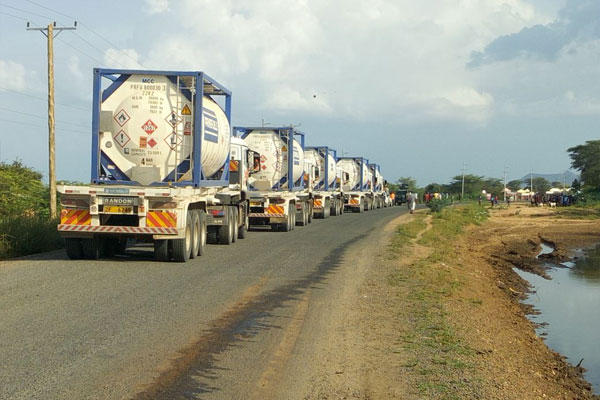
The sold consignment was delivered by truckers at the Kenya Petroleum Refineries facilities in Changamwe, Mombasa since July last year, under what the government described under the early oil project
What does this mean for Kenya and the East African region?
The deal concludes that Kenya once ruled off as an oil novice in the region, with the lowest volumes of discovered oil is running a head of its East African neighbors in reaching exporting oil country status many months before any of its East African neighbors can sell a drop of oil.
For Kenya, this is game changer in regional geopolitics as not only does the oil revenue bring a new line of foreign exchange earnings into its economy and thus consolidating its position as the regional economic superpower.
Galvanizing on its early market entry status, Kenya could tap the available markets and seal off any available contracts beating off any potential competition from its neighboring countries.
The oil revenues could also breathe some life into its Lamu Port South Sudan Ethiopia Transport (LAPSSET) Corridor development plan which has stalled for among others lack of partners. With oil revenues flowing, Kenya can go alone developing the ambitious infrastructure projects along the corridor all the way to the Ethiopian boarder.
Contrary to nay Sayers, the oil export could be a window to emboldened security in the Turkana area as the government seeks to protect vital oil installations and export routes to the coast. For many years, Lake Turkana basin has been one of the most volatile and insecure areas in Kenya as marauding armed warriors move from one village to another raiding for cattle. Civilians and military installations have been attacked and people killed.
In June, 2018 Turkana residents stopped five trucks from ferrying crude oil to Mombasa over rising insecurity along the border with Baringo. The resident complained of insecurity in the area but also complained of what they call consider unresolved issues on oil sharing benefits between the National governments, County governments and local communities over the 5% share which they wanted channeled to their bank accounts rather than for development as rallied by a section of leaders.
There is no way we can be a security threat to the oil we have protected and guarded for years. So the specialized and additional security personnel (protecting oil) should head to Kapedo and secure people.
Kenya’s oil export announcement could trigger a contagious rush for oil in the East African region, with each country racing to drill to bottom in search for oil. In an effort to outcompete each other, those already with oil discoveries such as Uganda and South Sudan could race to the market sealing off deals and contracts with potential buyers and agreements for future markets. Some of these deals maybe bad.
Uganda was the first to strike oil around its Albertine graben in 2005. According to Uganda’s Ministry of energy the petroleum deposit discovered so far were estimated at 6.5barrels of which 1.5bln are considered as recoverable.
The Ugandan oil is supposed to be exported to the global market through a 1,443 electric heated East African Oil Pipeline (EACOP) via Tanzania. The East African Crude oil pipeline is expected to unlock East Africa Oil potential by attracting invest and companies to explore the potential in the region.
According to the project schedule available on the EACOP website the detailed engineering and procurement and early works were supposed to have been made in 2018 and construction started in 2019. The first oil exports were expected in 2020. But it appears all these are behind schedule.
According to Ministry of Uganda expected to conclude its financial deal for its joint pipeline with Tanzania by June, 2019, opening for the way for its construction. According to the information provided by then, Stanbic Bank Uganda, was supposed to be the lead arranger for USD2.5billion funding for the 1,455 km (EACOP) project. The deal was expected to have been concluded in June, 2019.
Kampala was also expecting that the Final Investment Decisions (FID) between the government and the oil partners to determine when funds for the project will be made available, the terms of the financing and when the project execution will commence with a projected timeline between 20 and 36 months
The pipeline was expected to jointly develop the USD 3.5 billion pipeline, described as the longest electrically heated crude oil pipeline in the world. The balance of USD 1billion is expected to come from shareholders in equity
However, by the time Kenya announced its export deal in July, the earth breaking ceremony commencing the start of the EACOP pipeline construction had not started. Negotiations were reported as ongoing. In June 2017, the Daily Business Newspaper carried an article with a headline ‘Uganda’s Oil may not flow by 2020’ as the required infrastructure may not be complete by then[i]
What this means for Uganda is that time is of essence and the sooner the EACOP project construction takes off the better for its potential oil market.

Figure 3: The Government of Tanzania and Uganda sign the Inter-Governmental Agreement (IGA) for the East African Crude Oil Pipeline (EACOP) in May, 2017
So why do some oil projects like take long to materialize?
Lack of astute leadership, effective institutions and canning ambition to drive the projects to fruition. In some countries the political leadership and responsible institutions can be weak, whereby the essential operational process surrounding the oil projects can be clogged in political rhetoric and undertones which make decision making quite cumbersome, inefficiently slow and less assuring to the investors
Technical aspects such as Quality of crude oil discovered
High Sulphur crude oil can such as the Ugandan and Kenyan crude oil can be waxy and costly to transport via pipeline as it requires constant heating along the route. This explains why the 1,433 km EACOP is described as the longest electric heated pipeline in the world. This adds to complexity in technology and costs on heating required to operationalize the project. Investors may
Oil reservoir behaviors and recoverable volumes – The discovered oil reserves are not always the same as the recoverable volumes. In some projects the reserves can be large yet due to geological and technological factors the recoverable volumes are low. The behavior of the oil reservoirs is therefore a significant factor in determining whether the recoverable volumes will be consistent with the early projections and economic models over the plateau period. A change in the recoverable volumes can trigger massive losses and may lead to complete closure of the oil project. Investors are happy to rush projects where recoverable volumes will be sustained
Financing aspects such as financing structure -Lack of financing for some reasons or high interests on the investment loans secured from investment-lending institutions can be a delaying factor. The decision to invest may therefore take long as the investors or partners to the oil project juggle and weigh the available financial options viz a vis the current and future costs of the project on the country and the investors
Economic metric considerations such as the Net Present Value (NPV), Rate of Return (RoR) and Internal Rate of Return (IRR) of the project.
These are calculations undertaken to determine the economic and financial viability of the project. They are used to determine how much return and how long it will take to recoup the initial investment and starting generating profit.
According to online sources such as Investopedia, the Net present value (NPV) is the difference between the present value of cash inflows and the present value of cash outflows over a period of time. NPV is used in capital budgeting and investment planning to analyze the profitability of a projected investment or project.
The Rate of Return (RoR) is the net gain or loss on an investment over a specified time period, expressed as a percentage of the investment’s initial cost. This simple rate of return is sometimes called the basic growth rate, or alternatively, return on investment, or ROI. If you also consider the effect of the time value of money and inflation, the real rate of return can also be defined as the net amount of discounted cash flows received on an investment after adjusting for inflation.
The rate of return is used to measure growth between two periods, rather than over several periods. The RoR can be used for many purposes, from evaluating investment growth to year-over-year changes in company revenues. Its calculation does not consider the effects of inflation.
The internal rate of return (IRR) is a measure used in capital budgeting to estimate the profitability of potential investments. The internal rate of return is a discount rate that makes the Net Present Value (NPV) that makes the Net Present Value (NPV) of all cash flows from a particular project equal to zero. It is mathematically calculated as IRR=NPV=t=1∑T (1+r)t −C0 =0)
IRR is the rate of growth a project is expected to generate. The IRR is used in capital budgeting to decide which projects or investments to undertake and which to forgo.
Generally speaking, the higher a project’s internal rate of return, the more desirable it is to undertake. Assuming the costs of investment are equal among the various projects, the project with the highest IRR would probably be considered the best and be undertaken first. IRR is sometimes referred to as “economic rate of return” or “discounted cash flow rate of return.”
Social factors such as land acquisition and due diligence for compensation– The nebulous and intricate balancing act between the local laws and the international standards as guided by the International Finance Corporation can be a hindrance. Quite often the local standards for compensation can be law, corrupt unfair yet the IFC standards requires fair and equity
Negative diplomacy: The oil projects could delay or fail to take off all together due to negative diplomacy. Whereby disgruntled actors such as activists, companies, politicians who may not be excited or about the project may quietly lobby, urge, convince or cajole the financing institutions not to finance the project.
Security Risk: Oil projects cost lots of money in investment and thus require assurances that financial investments and their installations will be guaranteed. Oil projects can stall as investors and their partners gauge the security risks
Some or all of these factors could be now at play in the East African region and could be explanatory factors as to why some petroleum projects are progressing at a snail’s pace or stalled all together. Perhaps Kenya’s early oil export could be trigger for its neighbors to start thinking ahead.
[i] https://www.businessdailyafrica.com/economy/Uganda—oil—2020-Standard–Poors-Tanzania/3946234-3982464-j7rbsq/index.html