SADC in Economic Meltdown; Can Tanzania be German of the Region?

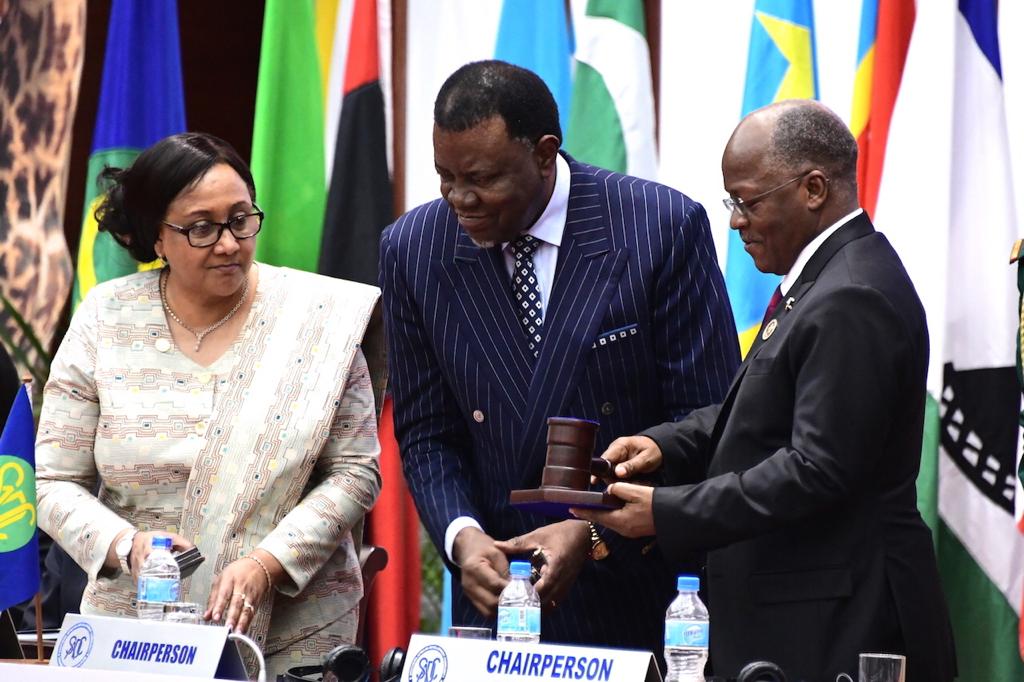
On Saturday 17th August, Tanzania assumed the chair of the South African Development Cooperation (SADC), amidst disturbing economic figures indicating that the region was facing a serious economic meltdown. Can Tanzania be the ‘German’ of the region, playing the economic big daddy role by calling the other states into political order and bailing out the struggling member states?

By Moses Kulaba, Governance and Economic Analysis Center, Dar es Salaam, Tanzania

The SADC is a 16-member state regional economic block established with among others promoting sustained economic growth and sustainable development amongst its objectives. However, the recent economic data indicates that region is witnessing an economic meltdown with most of its member states, except perhaps Tanzania, positing negative or stunted economic growth over the past years.

According to the economic and social indicators data compiled and released by its secretariat the the SADC region posted an estimated average growth rate of 1.4% in 2016 compared to 2.3% in 2015. At country level Tanzania registered the highest growth of 7% among the member states followed by Botswana with a far below rate of 4.3%[i].  

In 2017 Tanzania recorded an economic growth of 7.1% followed by Seychelles (6.3%) whilst Angola registered negative growth for the second consecutive year in order of 2.5%[ii] The region’s growth was increasing at a decreasing rate since the post global period in 2009.

The region’s economic giant South Africa has witnessed rapid economic slowdown, bring along its small neighbors and trading partners under its weight.  Countries such as Zimbabwe were collapsing under the weight of economic sanctions, Namibia and Angola recorded negative annual real GDP (at market price) of 10.8% and -2.5% respectively in 2017 due to the slump in commodity prices and other related risks. Botswana at 2.4% did not perform well either. The region posted an overall trade deficit with rest of the world of USD6.7bln. 

The AfDB report for 2018 warned that the economic outlook for Southern Africa region was cautious[iii]. Broad based economic activity was expected to recover at slow pace, but the outlook remained modest given the diverging growth patterns for the region’s economies. Upper middle income countries turned in low and declining rates of growth meanwhile lower income transitioning economies recorded moderate and improved growth, albeit at reduced rates.

Despite the improvement, economic performance remained subdued as the region’s economic outlook continued to face major headwinds. High unemployment, weak commodity prices, fiscal strain, increasing debt and high inflation.

Real GDP was estimated to have grown at an average of 1.6% in 2017 before increasing to a projected 2.0% in 2018 and 2.4% in 2019.

The future regional growth was expected to be bolstered with primary expectations of increased investment in non-oil sectors such as electricity, construction and technology in large infrastructure projects, mining as well as continued recovery in commodity prices.

However, the latest figures show that the region was not well on that front either.  The decline in commodity prices in recent years reaching the lowest point in 2015 translated into significant income loses for the economies, implying a negative impact on public and private sector spending and therefore growth in employment.

Before the 2008-2009 global recession, the region experienced moderate growth, though individual countries contributed differently. For example, Angola, Mozambique and Namibia exhibited robust growth that collectively outpaced the regional group.

Thereafter, Angola, the region’s foremost oil producer and former raising economic star received the worst bashing with its economy experiencing adverse economic growth effects due to weak oil prices.

Overall the region experienced negative GDP growth with Swaziland (-10.08%), Zimbabwe (-8.38%),  and Angola (-6.31%)  being among the worst hit[iv]  Other Countries such as Zambia, Namibia , Mozambique and Malawi were not performing better either. South Africa reported the highest public debt soaring in billions dollars followed by Angola.

South African Institute of International Affairs observed that intra-regional investment and trade levels had declined markedly since the commodity slump in 2013. Moreover, the trade and economic growth in the region remained imbalanced, exacerbating political strains among member states. Non-tariff barriers and other factors had adversely affected intra-regional trade and investment in recent years.

Assuming the mantle, at the end of its 39th Summit held in Dar es Salaam, Tanzania’ President John Pombe Magufuli was furious with against the Secretariat for having not provided adequate and alert to the political leadership that the region was experiencing an economic meltdown with reduced or stunted growth and an expanding trade deficit.

Speaking at the SADC People’s forum on the sidelines of the main summit in Dar es Salaam, the South African Professor, Patrick Bond, described the situation as alarming, catastrophic and turbulent and yet no one was bold enough to speak about it.

He was perhaps communist in view and radical in approach, blaming what he described as the capitalistic enterprise and its puppeteers for under mining economic justice, risking lives of by putting profit before the people and causing climate change whose effects were ravaging SADC but remained quite revolutionary in suggesting that the ordinary people perhaps needed to send a clear signal to its political leadership that all was not okay. The economic fundamentals were tattered and the regional leaders needed to wake, Prof. Bond lectured.

Can Tanzania emerge and become the ‘German’ of the region?

With this state of the Union, the question therefore arose can Tanzania emerge and become the ‘German’ of the region, playing the economic messiah role by providing both political leadership and economic bail out to its neighbors

In 2013 up to 2015 when the European Union experienced economic turbulence, Brussels turned to German to liberate it from the gigantic economic Dracula which was tearing down its economic block and leaving some of its small states indebted and facing bankruptcy. German wrote cheques in financial bailouts, provided guarantees and political prop up for economically struggling states such as Greece, Portugal and Italy.

German relied on its economic prowess and its political might as the industrial central pillar of the European Union. The charismatic leadership of its Chancellor, Ms Angela Merkel, was a distinct asset. Even at the risk of her own political career and constant onslaught from the German far right, Merkel could not tolerate any nonsense and was not ready to allow Europe to fall back.

In the face of the similar economic doldrums which seems now to face SADC, can Tanzania afford such muscle or a German equivalent?

Tanzania has done it before. In the 1960’s until 1990’s when the region was facing serious political, Tanzania pulled up its resources and committed it to the liberation struggle. It hosted training camps and provided pupilage to thousands of liberation fighters. Dar es Salaam became to the political headquarters of Frontline States where the idea of SADC in its current form was initiated and a spring for independence for many of the current South African states.  For some, therefore SADC at 39 years, just came back home.

In assuming the SADC Chairmanship, President Magufuli warned the Secretariat that it will not be business as usual as of now and for the next one year his interest would be to see that resources placed at the disposal of the Secretariat were not spent on conferences but on meaningful tangible projects which benefited the people. Could this be the kind of approach that region needs to take in order to deal with its increasing economic challenges.

An agile kind of leadership which places the people at the heart of politics and fights with cunning shrewdness against corruption, public waste, nepotism and personal drive to accumulate wealth by those in power.

Over the years these have been some of the vices which have dogged the region and bringing the much needed progress to stagnation and ultimate halt in some member states. Comparatively, perhaps the SADC is the largest economic group in Sub-Saharan Africa. With over an estimated population of 337.1 million people in 2017, is larger than its western equivalent, the Economic Community of West African States (ECOWAS) and obviously bigger than the European Union has a just a fraction of the SADC population yet somehow progress has been considerably steady in the other regions.

According to experts the region was faced by multiple non trade barriers and low intra region trade which still at around 20%.  Technically, speaking, the members are happy to do business with other countries outside the region rather than their economic neighbors partners in SADC. The member states are living alongside each other but not fully economically and trade integrated.

Political uncertainties which has dogged the former economic giants of the region such as South Africa, Zimbabwe, Mozambique and Angola created fertile conditions negative to investment and economic growth.  The governments lost grip on the economic mantle and directed attention towards managing internal politics and mechanics for political survival.  

Xenophobic attacks in South Africa could have also created a sense of fear and caused disarray in a fragile informal sector which was quietly the driving factor or fulcrum on which the South African economy relied. Crushing cost of electricity, turmoil in the extractive sector and stalemate in the platinum industry in 2016 perhaps were also a contributory factor to South Africa’s political woes. 

Overall, according, to Professor bond, the region was just poorly governed and a new leadership impetus led by the people was necessary to bring back the declining glories

For many years SADC was so much preoccupied on political stability. With good success, it has managed to tackle conflicts and bring peace amongst its member states. Overall, political conflict in the form of civil wars in the region has been declining with all except the DRC reporting any semblance of a conventional Civil war in recent years. 

Even, this has significantly been downgraded in recent years. Currently, there is no severe risk of any threat from any member state to destabilize any other through an arms insurrection. The ongoing conflict in the Eastern DRC is largely a war of survival for the remaining tribal and ethnic elements rather than a fully-fledged military configuration to overall and capture power in the DRC. If it can be dealt with, then perhaps the war in the DRC will be over or significantly reduced to minimal levels in many decades.

The future wars of the SADC will therefore be largely economic and perhaps resource based on key issues such as land, water and control of the real means of production and profit. Acute poverty could be the other driver of the masses towards insurrection. For Tanzania therefore, to take up the German challenge will be a touch endeavor.

Tanzania’s economic benefit or contribution to the region is too minimal. According to trade statistics, Tanzania is among the least exporters to SADC and its overall trade balance with its SADC neighbors was still low. It therefore lacks the economic might of German stature.

Over the past three years Tanzania’s political leadership has commitment itself to building its economy first before looking outside. Cutting back on public waste and flogging its population into line to start paying up taxes to finance its public service and infrastructure ambitions, Tanzania is building its economy from within.

Throughout the 1960s to the 1990s Tanzania sacrificed a lot in order to politically liberate virtually all the SADC member states and yet gained very minimal in return.  Political historians have even have even argued with some level of confidence that Tanzania under developed itself in sacrifice for others to develop. Tanzania would be therefore quite cautious in economic diplomatic terms and perhaps uncomfortable at this moment in giving out too much of what it has acquired over the years to salvage its economic neighbors.

The conditions in the region appear to have turned so bad in the past few years with persistent drought raving across the region only to be replaced by wrecking floods leaving behind famine and death in communities along its way.  Approximately over 1000 people dies in the last floods in Mozambique and Malawi caused by cyclone Idai and Keneth. Millions at a risk of starvation.  Essential infrastructure such as road and bridges connecting rural areas to urban centers and across countries such as the port of Beira are badly battered and incapable of supporting economic productivity.

The region has not been able to attract in Foreign Investment into its natural resource wealth and flagship infrastructure projects such as the Mighty Inga dam electro power project in the DRC which would have brought life into the SADC power master plan have remained incomplete for many years now. The region is badly in need of both reconstruction and reconfiguration to sustain itself and its ambitions.

At the end of the summit Tanzania’s former President Benjamin Mkapa advised that SADC member states should stop relying heavily on foreign donors for aid to support or finance their development agenda. Building internal capacity through a reliable market for products from the block, investment in education, technology, domestic revenue collection and unlocking the potential amongst its budging population to drive the economies forward would be a better option. Perhaps the SADC leadership should fine tune an ear to the wisdom of its elders.

The meeting concluded with signing off of three development cooperation programs worth 47 Million Euro deal with the European Union under its European Development Fund (EDF) 11 financing round. According to official statement, the funds will be used over the next five-year period to support improvement in the Investment and Business Environment (SIBE), Trade Facilitation Program (TFP) and Support to Industrial Productive Sectors (SIPS) three programs to be implemented by the SADC over the next five-year period

The SIBE program aims at achieving sustainable and inclusive growth and job creation by transforming the region into an investment zone, promoting intra-regional investments, foreign Direct Investment and a focus on Small and Medium Enterprises. The TFP will contribute to enhance inclusive economic development in the region through deepened economic integration while the SIPs aimed at contributing to the SADC industrialization agenda, improving performance and growth of selected value chains. How this EU injection translates into lifting the region from its economic downward spiral will yet to be found out at the next summit when SADC turns 40. What is clear is that something has to be done.

[i] SADC: Selected economic and social indicators, 2016

[ii] SADC: Selected economic and social indicators, 2017

[iii] AfDB: Southern Africa Economic Outlook, 2018

[iv] https://countryeconomy.com/countries/groups/southern-african-development-community
Election Coordination Mechanisms: A comparative study of Tanzania, South Africa and Nigeria

Proper election coordination is a major factor in successful elections in a multiparty democracy. The findings and key message coming out of a short policy study and governance practice note by GEPC suggests that there is no universal approach to coordination between Electoral Management Bodies (EMBs) and Office of Registrar of Political Parties (ORPPs). Each country has developed some sort of coordination based on its existing political and legal dispensation.

This short policy study and governance practice note sought to undertake a comparative study of Tanzania and South Africa, Nigeria with a view of contributing towards electoral reforms and minimizing of electoral disputes.

However when ranked on the common standards and guidelines for electoral management and  regulation of political parties, Tanzania scores unfavorably on a number of major aspects; Finality of decisions of its EMB (the National Electoral Commission) and Office of Registrar of Political parties, whereby there decisions are final and cannot be challenged in court,

The appointment of Tanzania’s National Electoral Commission (NEC’s) commissioners is not subject to a parliamentary vetting process, NEC’s mandate is limited to Presidential elections and local elections organised and supervised by local government executives under the Minister responsible for local government. The EMB and Officer of Registrar of political parties’ report to the responsible Minister compared to its comparative Countries such as South Africa and Nigeria where these institutions are answerable to parliament.

Tanzania only ranks in equal measure with its comparative peers EMB and Office of the registrar of its political parties in the as Constitutional bodies and its organs headed by persons of high integrity at a level of a judge or retired judge.

The study therefore recommends that as Tanzania prepares for the next local and general elections, the country should practical measures to

  • Review of current election coordination mechanisms with view of minimizing overlaps and election disputes
  • Implement Court decisions current and previous in regards to election related matters such as independent candidates and role of local government executives in election management
  • Increase avenues for transparent and objective dispute resolution. These should be documented and formalised in law
  • Adopt and adapt best practices from the comparative countries on matters related to election management and coordination, including opportunities to legally challenge the finality of decisions by the election coordination mechanism


A table summary of salient features of EMB and ORPP structures, functioning and coordination and our ranking based on European Commission (EC) Common Standards & guidelines for Electoral Management and Political parties Regulations [1]

  1. No Issue Explanation Traffic Signal
    1 Constitutional protection of EMB and ORPP Strengthens independence, confidence and performance Green
    2 Presidential Appointment of EMB Commissioners and ORPP heads Bad practice, Creates mistrust and may encourage patrimony Red
    3 Existence of Nomination Panel or Committee  for EMB Commissioners and ORPP Strengthens political and public trust in the institutions Green
    4 EMB and ORPP Chaired by Judge or Justice of high court May strengthen political and public trust that the actions and decision of these institutions are just and fair, but fair outcome is not guaranteed Yellow
    5 Civil Society involvement in Nomination of EMB Commissioners and ORPP heads Widens participation, increases public trust and credibility of the institutions Green
    6 EMB and ORPP embed Roles within a single institution such as IEC in South Africa or INEC in Nigeria May encourage ambiguity, Best to separate but also depends on accountability structures and clarity of the roles Yellow
    7 EMB and ORPP heads accountable to Minister Bad practice, may encourage direct political interference and patrimony Red
    8 EMB and ORPP heads accountable to Public Service Commission May be subject to limitations of public service administrative codes of conduct and requirements Yellow
    9 EMB and ORPP accountable to Parliament Increases accountability and public  scrutiny Green
    10 EMB and ORPP direct participation in nominations and vetting of candidates Encourages the EMB and ORPP to ensure candidate standing for election meet the eligibility criterion and legal requirements Green
    11 EMB and ORPP direct engagement in development of Party and Membership list for political parties Bad practice, Infringes on right of Political parties to determine their candidates Red
    12 Restriction of EMB and ORPP electoral  organization and coordination mandates to Presidential and Parliamentary elections (Tanzania’s case) Bad practice , may encourage direct political influence, foments elections disputes Red
    13 EMB and ORPP enforcement of Separate Codes of conduct or ethics Good to separate political issues from electoral matters Green
    14 EMB and ORPP separate Management of Party subventions, Financing Largely dependent on accountability structures Yellow
    15 Existence of EMB and ORPP elaborate operational procedures and independent guiding  law Provides clarity in operational mandates Green
    16 Existence of other constitutional institutions to support EMB and ORPP in democracy-such as  in South Africa Strengthens independence, trust and performance Green
    17 Decisions of EMB and ORPP Final on electoral and political matters Bad practice, May defeat justice and Fairness Red
    18 Detailed regulations for EMB and ORPP dispute resolution Provides clarity in dispute resolution Green
    19 Existence of formalised PPLC  and other similar bodies  to work with EMB and ORPP Enhances collaboration and potential dispute resolution Green
    20 Existence of an Independent Electoral Court or Tribunal to adjudicate on matters relating to EMB and ORPP Strengthens performance And expedites justice Green

     Comparative thematic analysis of Tanzania, Kenya, South Africca and Nigeria’s EMB and ORPP institutional setup, functions and our ranking based on European Commission (EC) Common Standard & guidelines for Electoral Management & Political Parties Regulation Standards[2]

    Issue Country Analysis Traffic sign


    Legal Constitution

    Tanzania EMB Constitutional body, ORPP enacted by law Green
    Kenya EMB  Constitutional Body, ORPP enacted by Green
    South Africa EMB and ORPP Constitutional bodies Green
    Nigeria EMB and ORPP Constitutional bodies Green


    Appointments

    Tanzania EMB and ORPP Commissioners and heads are presidential appointees, without nomination Red
    Kenya EMB and ORPP heads are presidential appointee , upon nomination Green
    South Africa EMB and ORPP Commissioners and heads are Presidential appointee, upon nomination Green
    Nigeria EMB and ORPP heads are Presidential appointees, upon nomination Green


    Leadership

    Tanzania EMB and ORPP headed by a Judge or Retired justice Green
    Kenya EMB and ORPP headed by  none Judges Red
    South Africa EMB and ORPP headed by a Judge Green
    Nigeria EMB and ORPP headed by a Judge Green


    Roles

    Tanzania EMB electoral mandated limited to Presidential and Parliamentary elections, Local elections organised by Minister Red
    Kenya EMB electoral mandate extended to organise all elections Green
    South Africa EMB mandated to organise all elections Green
    Nigeria EMB mandated to organise all elections Green


    Accountability

    Tanzania EMB reports to the Responsible Minister Red
    Kenya EMB reports to Parliament Green
    South Africa EMB reports to Parliament Green
    Nigeria EMB reports to parliament Green
     

    Jurisdiction

    Tanzania EMB organise elections partially in Zanzibar. Zanzibar President and House of Representative elections organised by Zanzibar Electoral Commission Yellow
    Kenya EMB has nationwide jurisdictive coverage Green
    South Africa EMB has nationwide jurisdictive coverage Green
    Nigeria EMB has nationwide jurisdictive coverage Green
     

    Dispute Resolution

    Tanzania EMB and ORPP decisions are final Red
    Kenya EMB and ORPP decisions challengeable in court Green
    South Africa EMB and ORPP decisions challengeable in court Green
    Nigeria EMB and ORPP decisions challengeable in court Green

    [1] We developed these common standards and traffic signals based on standard democratic and accountability principles, international conventions, international benchmarks and European Commission (EC) guidelines for Political Parties Regulation.

    [2] Ibid. The European Commission (EC) (Venice Commission) guidelines for Political Parties Regulation guideline provide an overview of issues regarding the development and adoption of legislation for political parties’ regulation in democracies.

    ** The full report of this study can also be downloaded from our reports and publications sections


One in four people in Africa pay bribes to access services, TI survey says

According to Transparency International (TI) survey report, more than 1 in 4 people in Africa who accessed public services, such as health care and education, paid a bribe in the previous year. This is equivalent to approximately 130 million people.

The tenth edition of Global Corruption Barometer (GCB) – Africa, released on African Anti-Corruption Day by Transparency International in partnership with Afrobarometer, reveals that more than half of all citizens surveyed in 35 African countries think corruption is getting worse in their country. Fifty-nine per cent of people think their government is doing badly at tackling corruption.

The largest and most detailed survey of citizens’ views on bribery and other forms of corruption in Africa, the survey asked 47,000 citizens in 35 countries about their perceptions of corruption and direct experiences of bribery.

The report also highlights that corruption disproportionately affects the most vulnerable, with the poorest paying bribes twice as often as the richest. Young people pay more bribes than those over 55 years old.

“Corruption is hindering Africa’s economic, political and social development. It is a major barrier to economic growth, good governance and basic freedoms, like freedom of speech or citizens’ right to hold governments to account,” said Patricia Moreira, Managing Director of Transparency International. “While governments have a long way to go in regaining citizens’ trust and reducing corruption, these things don’t exist in a vacuum. Foreign bribery and money laundering divert critical resources away from public services, and ordinary citizens suffer most.”

The police is considered the most corrupt institution, with 47 per cent of people believing that most or all police are corrupt. Many citizens also think government officials and parliamentarians are highly corrupt, at 39 per cent and 36 per cent respectively.

As in the previous edition of the GCB for Africa, the police consistently earn the highest bribery rate across the continent. This may be one of the reasons that two-thirds of those surveyed fear retaliation for reporting corruption. On a positive note, more than half of citizens believe that ordinary people can make a difference in the fight against corruption.

“To reduce the heavy burden of corruption on ordinary people, African states that have not done so should ratify and effectively implement the African Union Convention to Prevent and Combat Corruption,” said Paul Banoba, Regional Advisor for East Africa at Transparency International. “Africans believe they can make a difference. Governments must allow them the space to do so.”

Transparency International urges governments to put anti-corruption commitments into practice and to:

  • investigate, prosecute and sanction all reported cases of corruption in both the public and the private sector, with no exception;
  • develop minimum standards and guidelines for ethical procurement and build strong procurement practice throughout the continent with training, monitoring and research;
  • adopt open contracting practices, which make data and documentation clearer and easier to analyse and ensure transparency in hiring procedures;
  • create mechanisms to collect citizens’ complaints and strengthen whistleblower protection to ensure that citizens can report instances of corruption without fear of reprisal;
  • enable media and civil society to hold governments accountable;
  • support political party funding transparency;
  • allow cross border cooperation to combat corruption.

Authorities should also establish public registers that name the owners of shell companies and adopt and enforce laws that address stolen assets.

Additionally, business leaders and boards of companies, including multinational companies operating in Africa, should effectively and transparently implement the highest international anti-corruption and anti-money laundering standards.

The full report can be accessed via: https://www.transparency.org/gcb10/africa


No fiddling with Civic Space-CSOs affirm at Paris EITI Meeting

We demand that an independent, external review be commissioned to analyse the EITI’s tools to assess civil society participation; and we demand that Myanmar receive “meaningful” rather than “satisfactory” progress during its validation

By Governance and economic analysis centre team, Paris

At the Extractive Industries Transparency Initiative (EITI) global conference which took place in Paris between 17th and 20th of June 2019, Civil Society Organizations (CSOs) warned governments accross the world and vowed that they will not accept anything less than an unequivocal guarantee that Civic space and participation in EITI governance processes will continue to be safe guarded and protected.

This followed what CSOs described as an encroachment on Civic space by selective interpretation and application of the EITI standard.

A collective statement issued by the global CSO extractive transparence movement coordinated by Publish What you Pay observed that Civic space is shrinking worldwide, including many EITI Countries. Civil society is carefully monitoring the situation and gravely concerned with what we see.

The EITI is a global standard for good governance for the oil, gas and mineral resources currently implemented in 52 Countries around the world.

In recent board decisions, the board has taken what CSO view as a double standard or non-balanced approach in interpreting the standard. We have seen some Countries punished for violating the CSO protocol while others are treated with ‘kid gloves’

The Standard requires that member states undergo regular validation on implementation of the EITI Standard after which implementing states are ranked as having achieved either satisfactory or made meaningful progress or suspended for failure to meet the standards. Under extreme conditions countries are delisted from the EITI. The status of the EITI in different implementing Countries can be viewed via:  https://eiti.org/

The Civil society protocol is one of the benchmarks required to be assessed during the EITI validation and implementing countries are required to demonstrate that the operational environment in the country is conducive for civil Society to freely operate and participate in the extractive sector governance.

To achieve accountable management of natural resource citizens must have access to relevant information about the sector is managed. EITI’s main historical purpose is to provide this transparency. Civil Society has been a driving force behind progress in the types of transparency and granularity of data provided by the EITI over the years, most recently with advocacy on contract transparency.

Transparency should be accompanied by meaningful participation. Participation is about the ability of people to have agency in natural resource governance decisions that directly affect them or their livelihoods.

How to interpret and enforce EITI requirements for civil society participation has been contentious and recurring over years. It has been debated in relation to a number of countries such as Equatorial Guinea, Ethiopia, Azerbaijan and Niger. In recent years both Azerbaijan and Niger have withdrawn from the EITI after facing suspension linked to Civic space concerns.

Several times have been made to clarify the interpretation and enforcement of civil society participation; notably with 2015 civil society protocol.

These documents make it clear that EITI is meant to assess the general political environment and that EITI requirements cover any civil society expressing views related to natural resources government (not just MSG-Members) along a spectrum of activities, expression, operation, association engagement and access to public decision making.

None the less, interpreting and enforcing EITI’s requirements regarding civic space remains contentious, more recently with the validation of Myanmar.

Against a backdrop of shrinking space globally, now is the time to review whether EITI’s mechanisms for assessing civic space are fit for purposes and serving the broader objective: Ensuring civil society’s ability to participate freely, independently and meaningfully in the national dialogue on natural resource governance.

According to data provided by the Civicus Monitor indicates that our of 50+ EITI implementing Countries 40 have seriously restricted Civic space, including 2 listed as closed. 13 repressed, 25 obstructed and a further 6 with narrowed Civic space and 5 as open.

Activist working on transparency in the extractive sector are among the most targeted globally. Attacks against activists working on transparency in the extractives include killings, torture and disappearances as well as criminalization of their activists. The business and human rights resource centre has identified attacks on human rights activists working on business related activities in approximately 36% of the 50+ EITI implementing Countries in the last three years.

Myanmar represents a test case for how the board assess requirement 1.3 and will be a bell weather for similar scenarios in Countries like the Dominican Republic. It is important to uphold EITI’s commitment to review the broader environment in which EITI operates and to assess whether the broader objective of Civil society protocol has been fulfilled, Ms Elisa Peter, Executive Director of Publish What You Pay Global CSO Coalition stated.

What Does this year’s budget have for you?  How Tanzania, Kenya and Uganda prepare and manage their budgets differently to minimise perpetual deficit


As East Africans continue to dissect and internalise what impacts this year’s national budgets will have on the economy and standards of ordinary citizens, the questions remain whether these budget targets can be achieved. But what are national budgets and how have these coveted statements and speeches resonated with citizens interests over time? The trend and results from previous budgets show mixed feelings and perhaps, it is time to reflect on how national budgets are made. 

By Moses Kulaba; Governance and economic analysis centre

What are national budgets?

A national budget is a statement of how government plans to raise and spend revenue or public money collected from various domestic and external sources. Domestically, the government largely raises revenues through taxation.

The legendary Economist and tax theorist Adam Smith stated that states as sovereign entities have the right to impose taxes and to spend these proceeds from taxation to meet the public financial needs of its citizens. 

The tradition of taxation is rooted in ancient empires which required that every able citizen makes a mandatory contribution to the state and in return the state provides protection and social services.

Taxes in ancient Egypt, Greece and Rome were charged to finance war but the idea of sales taxes, income taxes, property taxes, inheritance taxes, estate taxes, gift taxes are said to be a modern invention. The concepts of taxation that evolved and developed were transported to other empires and cultures where tax ideas took root. This pattern continues through today as nations are influenced by tax practices from other Countries

There is no art which one government sooner learns than that of draining money from the pockets of people-Adam Smith

In commonwealth traditions, proposed government collections and expenditures are articulated in a national budget statement and speech always presented before the state parliament or legislature on the budget day. In Tanzania, this is presented on every second Thursday of June of every year.

What are the key priority areas for this year’s national budgets?

The budgets from the three East African states appears to have been informed by the regional consensus on theme of promoting industrialisation. Driven to achieve this objectives governments have reshuffled its priorities towards agenda with Tanzania and Uganda pushing this through the five-year development plans while Kenya pushes its big four agenda.

Country

2018/19

2019/20

Tanzania

  1. Industrialisation
  2. Agriculture
  3. Social Services
  4. Infrastructure
  1. Industrialisation
  2. Infrastructure development and power generation
  3. Aviation sector

Kenya

  1. Infrastructure
  2. Education
  3. Information, Communication and Technology
  4. Poverty reduction and social protection
  5. Security for investment, growth & employment
  1. Education
  2. Energy, infrastructure, information, communication and Technology
  3. Public Administration
  4. Governance, justice, law and order
  5. National Security

Uganda

  1. Commercialisation of agriculture
  2. Industrialisation and productivity enhancement
  3. Financing private sector investment
  4. Minerals development
  1. Works and Infrastructure investment
  2. Debt repayment
  3. Security
  4. Education
  5. Mineral development

Who are the winners and losers?

Across the East African region, the major beneficiaries were the manufactures. The major beneficiaries in Tanzania are horticulturalists, manufacturers of packing materials and baby diapers. VAT has been exempted on imported refrigeration boxes used for horticultural farming while all imported horticultural products will be charged 35% instead of 25%.  Zanzibaris have a reason to celebrate as supply of electricity services from mainland Tanzania to Zanzibar will be zero rated. The tourist sector has also won big with reductions in taxes on some specific packages such as game hunting. While airline operators will have a sigh of relief airline tickets, flyers, staff uniforms and aircraft lubricants are VAT exempted.

Motorists and women will obviously take a brunt of the budget as the tax man has increased taxes on driving licence fees from Tsh 40,000 to Tsh 70,000 and registration card fees for all forms of motor cycles from Tsh 10,000 to Tsh20,000. The tax man has targeted women imposing 10% duty on locally produced synthetic hair whereas imported artificial hair will be charged at 25%. VAT on sanitary pads has been abolished.

In Kenya the manufactures are winners with a withholding VAT rate reduced from 6% to 2% and introduction of a refund formula which expedites VAT refunds and ensures a full refund of input tax credit rating to zero rated.  Agriculturalists have reason to celebrate with Ksh 1.0bln diversification and revitalisation of Miraa and Ksh 3.0bln for setting up the Coffee Cherry Revolving Fund, aimed at implementing prioritised reforms in the coffee subsector.  Digital employees have a reason to celebrate as they will enjoy an exempted tax on income earned under the Ajira Program. The measure is aimed at enabling over 1million youth to be engaged as a digital freelance worker. The health sector has some reasons for joy as an additional to Ksh47.8ln is allocated to expand access to Universal Health Coverage from 4 pilot counties to other counties.

Meanwhile drunkards and gamblers will continue to leak their wounds as they ache out an additional 10% in taxes is slapped on betting and 15% on tobacco and alcoholic drinks. Boda Boda and Tuk-Tuk riders will face an uphill task with amendments to the Insurance (Motor Vehicle third party risks certificate of insurance) rules to require all passenger carrying riders to have an insurance cover for passengers and pedestrians.

In Uganda, the works and infrastructure continue to enjoy a good share of the budget with Ush6.4trillion of the budget allocated to it.  The industrialists are perhaps the biggest winners with generous tax exemptions allocated for industrial parks expanded to 10 years for letting, leasing or expanding existing developers with capital of at least USD50Mln and operators with at least USD10 Mln capital.  There has been an introduction of income tax exemption on interest paid on infrastructure bonds such as listed bonds and securities. Removal of withdrawing on agriculture supplies and listing and other similar goods. Exemptions on aircraft insurance services, supply of services.  A beneficial owner and citizen have also been redefined to be in line with the East African Community Court ruling in the case of BAT Vs URA.   The importers of fresh or chilled or cooked potatoes, honey, granite, marble and ceramics are net losers with increased customs duties.

Amidst of all these changes in estimates, significant to note is that new creatives sources of tax revenues were presented.

Governments have perpetually faced narrow taxes bases with potentially same traditional sources facing the tax man. In recent years the government have developed affinity to indirect taxes, despite their regressive nature and inequitably targeting of the poor

What have been the trends?

Country

2017/18

2018/19

2019/20

Kenya

Ksh 2.3bln

Ksh 2.5bln

Ksh3 trln

Tanzania

Tsh 31.7trln

Tsh32.4trln

Tsh 33.11trln

Uganda

Ush 29 trln

Ush 32.7 trln

Ush 40.487trln

The trend shows that budgets estimates have been increasing over the years with this year’s budgets touted as the highest since independence. However, the actual budget out turns have fallen short of projections. Kenya, which is the biggest economy in the region has missed targets for the past seven years

In 2018/19 Tanzania recorded a shortfall in budget outturn only achieving 88% of its targeted revenue collection. This was attributed to a number of factors

  • Decline in domestic revenue
  • Tighter global conditions
  • Decline and delayed disbursement in government

The trends from previous budgets show that the government has been largely a net borrower and net spender. Governments rely heavily on domestic and external borrowing to fill its budget deficits. Very little is saved.

Generally, Government debt as a percent of GDP is used by investors to measure a country ability to make future payments on its debt, thus affecting the country borrowing costs and government bond yields.

Over the years the governments debt to GDP ratios have spiralled reaching record highs.  According to government statistics in Tanzania the debt to GDP ratio hit 34.2 % by end of 2017. The Bank of Tanzania reported that the external debt stock comprising of public and private sector debt amounted to USD 21,529mln at end of March 2019. Uganda’s debt to equity ratio was 41.2%.  Kenya’s debt to GDP ration was at a record 57.5% in 2017 and around 55 % in 2018.

Governments have constantly argued that their debt obligations are manageable and the current borrowing appetite is aimed at achieving a favourable debt mix of short term and long-term loans. The down side of appetite is that as government piles new debts, the maturity period of old debts is too short and puts a lot of pressure on government revenues to pay. In Uganda for example 11% of this year’s budget will be spent on debt repayment.

The debt burden is worsened by the near stagnant revenue growth, the Ugandan Planning Minister acknowledged in 2018. “Our tax base is not growing at the same rate,” he added, putting the tax to Gross Domestic Product (GDP) ratio at 14.3 per cent.

The government spends most of its money on recurrent expenditures such as salaries and its development budget on mega infrastructure such as roads, power generation and aviation have not been quick in generating commensurate revenues, leaving governments with perpetual financing gaps every budget year.

The question then which emerges is why increase budgets when the revenue targets for the previous years have not been met?

Do governments need to adopt a saving culture-amidst all.

As meeting domestic revenue targets becomes doggy and external aid and borrowing stringent, how can governments manage their budgets to ensure that some of the revenues collected are saved and used to cushion future deficits. The governments have options that can be considered.

Adopting a cost cutting

Cutting of nugatory public expenditures spent on running public administration can save governments massive recurrent expenditures on salaries and allowances. While Kenya has adopted a heavy devolution structure costing government billions of shillings to run Uganda has the largest cabinet in the East African region. The Ugandan government has rapidly created economically unviable local government districts, who rely heavily on central government subsidies to survive.

Adopting revenue saving culture

The government can adopt a revenue saving culture. Revenue management is largely a tax policy concern which hinges on economics that revenues from various sources should be spent in a sustainable manner to avoid long-term shortfalls and economic instabilities that might affect the overall economic tax base.

These views are reflected in Hugh Dalton’s ‘principles of maximum social advantage (Marginal Social Sacrifice theory) and  Arthur Pigou’s ‘principle of maximum social welfare benefits’ (Marginal Social Benefit)  theories of taxation and public expenditure which suggest that taxation (government revenue) and government expenditure as two key tools of public finance have to be balanced to achieve maximum social benefits. Neither excess is good for the society.

Sustainable economic growth can therefore be achieved when government balances its short term and long-term public revenue and expenditure needs.  The government does not need to exclusively spend on infrastructure or welfare benefits but it also needs to save and spend on strategic investment to safe guard its future revenue sources.

This saving culture should be embedded in a country’s budget policy and revenue expenditure management system and fiscal regimes governing expenditures of its revenue.

Investing in foreign government financial instruments

The governments can take the Japanese and Chinese approach of investing in foreign government financial instruments.  Globally, the Japanese and Chinese are among the highest investors in the United States government securities. Controversial as it may look, but by investing its wealth in secure foreign government bonds, the government can ensure that the dividends realised are ploughed back into the Country to support its economy.

This type of foreign investment has made it possible for the Japanese able to finance their domestic debt which is almost above 233% of GDP.  The other difference between Japan and other countries is that its debt is held by its Citizens.

Many other countries, including Greece, owe mostly to foreign creditors. However, most of Japan’s debt (including government bond liabilities) are held by its own citizen, so the risk of defaulting is much lower. Japan is still well-off because it can adjust interest rates at low levels so that repayment values stay low relative to the overall debt level.-Forbes

Introducing effective currency management

The governments can adopt the Egyptian model of devaluing its currency to ensure that the country exports more and attracts more foreign currency into the country than it spends in payment and servicing external debt. The attracted foreign income is invested into production to boost economic growth.  As an economy grows to higher level, it becomes able to generate enough revenues to pay off or reduce its debt burden.

Helpful Further Readings and references

  1. Afosa, K. (1985), ‘Financial Administration of Ancient Ashanti Empire’, The Accounting Historians Journal, Vol. 12(2), pp. 109–115.Google Scholar
  2. Blakey R. G. and Blakey, G. S. (1940), The Federal Income Tax, New York, Longman Green and Company.Google Scholar
  3. Crum, R. P. (1982), ‘Value-Added Taxation: The Roots Run Deep into Colonial and Early America’, The Accounting Historians Journal, Vol. 9(2), pp. 25–41.Google Scholar
  4. Garbutt, D. (1984), ‘The Significance of Ancient Mesopotamia in Accounting History’, The Accounting Historians Journal, Vol. 11(11), pp. 83–101.Google Scholar
  5. Jose, M.L. and Moore, C.K. (1998), ‘The Development of Taxation in the Bible: Improvements in Counting, Measurement and Computation in the Ancient Middle East’, The Accounting Historians Journal, Vol. 25(2), pp. 63–80.Google Scholar
  6. Kozub, R.M. (1983), ‘Antecedents of the Income Tax in Colonial America’, The Accounting Historians Journal, Vol. 10(2), pp. 99–116.Google Scholar
  7. Mann, H. (1984), ‘ Thus Spake The Rabbis-The First Income Tax?’, The Accounting Historians Journal, Vol. 11(1), pp. 125–133.Google Scholar
  8. Paul, R.E. (1954), Taxation in the United States, Boston: Little Brown and Company.Google Scholar
  9. Samson, W.D. (1985),The Nineteenth Century Income Tax in the SouthThe Accounting Historians Journal, Vol. 12(1), pp. 37–52.Google Scholar
  10. Samson, W.D. (1996), ‘The Evolution of the U.S. Income Tax: The History of Progressivity and Influences from Other Countries,’ in A. Richardson (Ed), Disorder and Harmony: 20th Century Perspective on Accounting History, The Seventh World Congress of Accounting Historians (CGA Canada Research Foundation Research Monograph No. 23), pp. 205–227.Google Scholar
  11. Seligman, E.R.A. (1909), Progressive Taxation, New York: MacMillan Company, 2nd edition.Google Scholar
  12. Seligman, E. R.A. (1911), The Income Tax, New York: MacMillan Company.Google Scholar
  13. Seligman, E.R.A. (1931), Essays In Taxation, New York: MacMillan Company.Google Scholar
  14. Shultz, W.J. (1926), The Taxation of Inheritance, Boston: Houghton Mifflin Company.Google Scholar
  15. Smith, A. (1976), An Inquiry into the Nature and Causes of the Wealth of Nations, Oxford: Clarendon Press.Google Scholar
  16. Solas, C. and Otar, I. (1994), ‘The Accounting System Practiced in the Near East During the Period 1220–1350 Based on the Book Risale-I Felekiyye’, The Accounting Historians Journal, Vol. 21(1), pp. 117–135.Google Scholar
  17. Wells, S.C. and Flesher, T. K. (1994), ‘Lessons for Policymakers from the History of Consumption Taxes’, The Accounting Historians Journal, Vol. 21(1), pp. 103–126.Google Scholar
  18. Yeakel, J.A. (1983), ‘The Accountant-Historians of the Incas’, The Accounting Historians Journal, Vol. 10(2), pp. 39–51.Google Scholar
What is state capture and its impacts on political governance in Tanzania

What is state capture and its impacts on political governance in Tanzania

By Moses Kulaba, Governance and economic analysis centre, Dar es Salaam-Tanzania

State capture can be simply defined as a way in which individuals, corporations, organizations or groups of organizations and interest groups such as political elites, business interests, cartels and criminal gangs influence government decisions, structures and processes through political or quasi political systems and structures with an intention of promoting, protecting and achieving their own interests.

There are two major types of state capture: These are spectrum state capture, which involves individuals having undue influence on decision making processes in government and Oligarchy, which involves organized cartels, organized groups of individuals and syndicates controlling and influencing government decisions and processes. Examples of oligarchies include the famous Russian Oligarchies and cartels include the South American (Colombia and Mexican) drug cartels such as Sinaola drug cartel under the leadership of Joaquin Guzman, famously known as ‘El Chapo’

The impact of state capture on the proper functioning of the state is enormous in a sense that state capture affects government’s ability to function and make proper decisions. State capture has also been with the famous term called kleptocracy, which is essentially stealing from the state coffers for private gain.

State capture leads to creation of a rent seeking state, where corruption shrives, becomes systemic and entrenched in government and public service. In a rent seeking state, key public services such as health, jobs are only received after paying bribes and ‘back shisi’ to government officials and those entrusted to serve the public.

It causes bad public spending as the corrupt secure lucrative public tenders for procurement and supply of essential goods and services to government. The procured supplies or goods may be over priced, of poor quality or never supplied at all.

It creates an unfavorable business environment where the politically connected businesses with influence on the national leadership and state organs manipulate, influence and secure government decisions, regulatory frameworks and protection in favour of their business interests.  Small legitimate businesses either seek protection of the big corrupt businesses or collapse under the weight of unfair competition.

It significantly affects the rules of justice, law and order where by individuals, corporations or groups ‘capture’ institutions of justice and influence judges and high ranking officials of the judiciary, law and order sector through bribes to protect or make decisions in favour of their private interests.

It also affects national security as the corrupt individuals, corporations or groups use their influence to infiltrate the system by ensuring their collaborators secure jobs in the government security apparatus. Through these connections and influence, top national secrets may be shared with these individuals, businesses or cartels for private gain. They are also able to use the government security apparatus and resources such as police, military and arms for protection.

Through illicit political party financing, election fraud and intimidation, state capture may lead to ascension to power of bad leadership.  This is achieved through financing political of political parties and sponsorship of candidates whom they deem to be in their favour. Once in power, the elected political leaders are influenced to make corruption deals, award tenders and protection as reciprocal gesture to their political god fathers.

Governance, Corruption and State Capture

There is still corruption and corruptive behaviour in public service structures and as a consequence corruption is still recognised as one of the major governances and development obstacle to poverty eradication. Corruption has affected both the quality of social service delivery and business development. According to the World Bank doing business index report of 2012 Tanzania was ranked as 127th position out of 183 Countries. Corruption is ranked as a major impediment to doing business. The level of unpredictable political and economic policy regimes in the region have increased the level of risk to doing business and trade in the country and the region. Regional Political instability and uncertainties of regime change have created social anxiety, economic stagnation, political distress and conflicts.

In a nutshell key government institution like the electoral management, Judiciary and law enforcement are under ‘capture’ by acts of corruption and bribery which have seen these institutions ranked consistently as the most corrupt in the region for the past years